Ipinapakita ang mga post na may etiketa na DAANG TUWAD. Ipakita ang lahat ng mga post

Martes, Agosto 26, 2014

MAY SIRA SA ULO SI KIM HENARES


"EH DAPAT NGA I-TAX NA RIN ANG MGA SARI-SARI STORE OWNERS . . . ."


"DAOT BA KA OG OTOK MISS?"

OPINION


Seditious
Why would President Aquino III seek to weaken the Supreme Court?  Has he gone mad? He already made Congress an adjunct of the Presidency by usurping the congressional power of the purse.  Shouldn’t he be working for the strengthening of political institutions as a way of making the country’s budding democracy stronger and enduring?
If Mr. Aquino was truly committed to a system of government that is different from the authoritarian regime that the 1987 Constitution sought to replace, he should embrace, not fight, the Supreme Court decision that ruled his Disbursement Acceleration Program (DAP) unconstitutional.
The Philippine Constitutional Association (Philconsa) was right when it described as “seditious or treasonous” President Aquino’s motion for the Supreme Court to reconsider its unanimous ruling that the DAP is unconstitutional.
“To initiate or encourage any measure to subvert or undermine or spoil the enforcement of the unanimous decision of the Court applying and interpreting the Constitution is seditious or treasonous. It is a mutiny against the Constitution,” Philconsa warned.
Why should Mr. Aquino try to weaken the Judiciary, and consequently strengthen the Presidency, when the Philippine president is unquestionably already very powerful.   In fact, the Philippine president  is stronger than the President of the United States, the mightiest militarily and most democratic country on Planet Earth.
In a tripartite system of government – the Executive, the Legislature, and the Judiciary – the President, representing the Executive Department, is primus inter pares (a first among equals).
The President is the Commander-in-Chief of 129,780-strong armed forces of the Philippines. He commands a 196,245 police officers and men of the Philippine National Police.  In most countries, peace and order is a local concern and thus implemented by local authorities. In the Philippines, the Philippine National Police is national in scope and hence under the direct
command and supervision of the President.
The President supervises all local government units – the 81 provinces, 144 cities, 1,490 municipalities, and 42,028 barangays.
The President is the country’s chief executive officer (CEO). He is the boss of some 1.2 million civil servants. Compare that with Congress’ 6,084 workers (one half of one percent of the entire bureaucracy, and with the Judiciary’s 25,247 justices and court employees, or about 2.1 percent of the entire bureaucracy.
The President commands an army and a national police. He controls the biggest chunk of government resources. Remember, he is just one individual exercising all these awesome powers. He can be a virtual dictator within the Executive Department.  He can decide quickly and implement such decision promptly.
By contrast, the other co-equal branches of government – Congress and the Supreme Court – are collegial bodies. Decision-making is slow, oftentimes tedious, and decisions are arrived at through consensus. Notice, for example, how long it took the High Court to decide on the DAP issue.
Once a law is passed, Congress has no way of compelling the President to implement it; hence, the existence of many unfunded and unimplemented laws.  Unless some concerned individuals or groups bring the case to the Supreme Court, there is no way such unimplemented laws may be enforced. Congress has no army of its own.
But even if the Supreme Court rules against the President, the High Court has no way of compelling the President to implement its decision. The Supreme Court, too, has no army of its own.
That is why honoring and respecting the rule of law is expected of all public officials. No less than the President has sworn to “uphold and defend” the Constitution of the Philippines.
Relative to the President, Congress is weaker because of its bicameral structure. In order to control Congress, all that the President has to do is control one of the two Houses of Congress.  Mr. Aquino controls both Houses.

ON BUDGET MAKING AND IMPLEMENTATION, PHILIPPINE PRESIDENT IS MORE POWERFUL THAN THE US PRESIDENT

On budget making and implementation, the Philippine president is more powerful than the US president. First, the Philippine president has line-item veto power. Through it, the president may line out specific items in the General Appropriations Bill (GAB) and then sign the modified bill into law.
By comparison, the US President does not have line-item veto power. US Presidents have been asking for line-item veto power for a long time.  It was in 1876, during President Grant’s term of office, that the line-item veto power was first raised before Congress.  In 1996, the US Congress passed the Line Item Veto Act, which then President Clinton signed into law.
Several senators challenged it and raised the issue before the US Supreme Court, which found the law unconstitutional. The High Court ruled that the law violates the Presentment and Bicameral Clauses of the Constitution (Article I, Section 7, Clauses 2 and 3) that vests Congress with “all legislative powers.”  Moreover, the “Non-delegation Doctrine” holds that one branch can’t transfer its constitutional powers to another branch or entity.
Second, in implementing the budget the Philippine president is not constrained by an Impoundment Control Act (ICA 1974), which the US president has to face. The ICA 1974 restricts the President’s power to impound appropriations.
The ICA 1974 gave the US President the power to both delay the expenditure of funds (deferral authority) and to cancel funds (rescission authority). But, to rescind funds, the President needs congressional concurrence within 45 days. In practice, Congress has ignored most Presidential requests to cancel funds.
Third, under existing Philippine budget rules, the budget of the previous year is automatically reenacted should Congress fail to approve the ensuing budget before the start of the fiscal year. Hence, there does not exist any threat that government operations will come to a halt should Congress delay the passage of a new general appropriations act.
In reality, Congress may not hold the President hostage by threatening to stall budget approval. In the US, the threat of stalling the approval of the budget (s) [since the US Congress approves several disparate budgets], and hence closing down part of government, is all too real. It has happened before and it could happen again in the future.
The US President is subject to ‘blackmail’ by an uncooperative Congress; the Philippine President is not since the Constitution provides for the automatic reenactment of the previous budget pending approval of a new budget.
All the foregoing discussions point to one indisputable fact: the powers of the Philippine President vis-à-vis Congress and the Judiciary are, right now, quite awesome.
The Philippine president’s budget formulation and implementation powers are even more formidable than those of the US President.
Hence, Mr. Aquino’s obsession to weaken the Supreme Court, and by implication strengthen the powers of the President, is at best, quizzical, and at worst, insane.
In his final days in Malacanang, Mr. Aquino should seek to rebuild and strengthen, rather than weaken, political institutions. In addition, he should spend his limited time solving the more crucial social and economic problems like hunger, poverty, unemployment, and the crumbling public infrastructure

Sabado, Nobyembre 16, 2013

ANG LOCAL GOVERNMENT PO MAY KASALANAN

"the local government was first in line. . . . but . . .i guess they were not prepared . .as they were supposed to be the first responders . . . . .blah . . blah . . .blah . . ."
                            "Yeah, right."

TANONG NG ISANG BUBWIT

So, dahil si Romualdez relative ng mga Marcoses, ayaw mo ng tulungan ang mga taga-Tacloban?

Ganun na lang ba yon Mr. Noynoy?

Biyernes, Setyembre 20, 2013

POPE FRANCIS IS A DANGEROUS MAN.

Pope Francis, CIA and ‘Death Squads’

Global Research, March 18, 2013
In the 1970s, Father Jorge Bergoglio faced a moment of truth: Would he stand up to Argentina’s military neo-Nazis “disappearing” thousands including priests, or keep his mouth shut and his career on track? Like many other Church leaders, Pope Francis took the safe route, Robert Parry reports.
The election of Argentine Cardinal Jorge Bergoglio as Pope Francis brings back into focus the troubling role of the Catholic hierarchy in blessing much of the brutal repression that swept Latin America in the 1970s and 1980s, killing and torturing tens of thousands of people including priests and nuns accused of sympathizing with leftists.
The Vatican’s fiercely defensive reaction to the reemergence of these questions as they relate to the new Pope also is reminiscent of the pattern of deceptive denials that became another hallmark of that era when propaganda was viewed as an integral part of the “anticommunist” struggles, which were often supported financially and militarily by the U.S. Central Intelligence Agency.

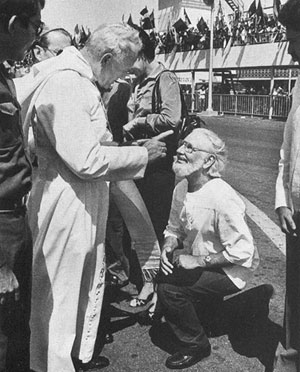
Image: Pope John Paul II reprimanding Father Ernesto Cardenal at Managua Airport for Cardenal’s support of “liberation theology” and his work with the Sandinista government.
It appears that Bergoglio, who was head of the Jesuit order in Buenos Aires during Argentina’s grim “dirty war,” mostly tended to his bureaucratic rise within the Church as Argentine security forces “disappeared” some 30,000 people for torture and murder from 1976 to 1983, including 150 Catholic priests suspected of believing in “liberation theology.”
Much as Pope Pius XII didn’t directly challenge the Nazis during the Holocaust, Father Bergoglio avoided any direct confrontation with the neo-Nazis who were terrorizing Argentina. Pope Francis’s defenders today, like apologists for Pope Pius, claim he did intervene quietly to save some individuals.
But no one asserts that Bergoglio stood up publicly against the “anticommunist” terror, as some other Church leaders did in Latin America, most notably El Salvador’s Archbishop Oscar Romero who then became a victim of right-wing assassins in 1980.
Indeed, the predominant role of the Church hierarchy – from the Vatican to the bishops in the individual countries – was to give political cover to the slaughter and to offer little protection to the priests and nuns who advocated “liberation theology,” i.e. the belief that Jesus did not just favor charity to the poor but wanted a just society that shared wealth and power with the poor.
In Latin America with its calcified class structure of a few oligarchs at one end and many peasants at the other, that meant reforms, such as land redistribution, literacy programs, health clinics, union rights, etc. But those changes were fiercely opposed by the local oligarchs and the multinational corporations that profited from the cheap labor and inequitable land distribution.
So, any reformers of any stripe were readily labeled “communists” and were made the targets of vicious security forces, often trained and indoctrinated by “anticommunist” military officers at the U.S.-run School of the Americas. The primary role of the Catholic hierarchy was to urge the people to stay calm and support the traditional system.
It is noteworthy that the orchestrated praise for Pope Francis in the U.S. news media has been to hail Bergoglio’s supposedly “humble” personality and his “commitment to the poor.” However, Bergoglio’s approach fits with the Church’s attitude for centuries, to give “charity” to the poor while doing little to change their cruel circumstances – as Church grandees hobnob with the rich and powerful.
Another Pope Favorite
Pope John Paul II, another favorite of the U.S. news media, shared this classic outlook. He emphasized conservative social issues, telling the faithful to forgo contraceptives, treating women as second-class Catholics and condemning homosexuality. He promoted charity for the poor and sometimes criticized excesses of capitalism, but he disdained leftist governments that sought serious economic reforms.
Elected in 1978, as right-wing “death squads” were gaining momentum across Latin America, John Paul II offered little protection to left-leaning priests and nuns who were targeted. He rebuffed Archbishop Romero’s plea to condemn El Salvador’s right-wing regime and its human rights violations. He stood by as priests were butchered and nuns were raped and killed.
Instead of leading the charge for real economic and political change in Latin America, John Paul II denounced “liberation theology.” During a 1983 trip to Nicaragua – then ruled by the leftist Sandinistas – the Pope condemned what he called the “popular Church” and would not let Ernesto Cardenal, a priest and a minister in the Sandinista government, kiss the papal ring. He also elevated clerics like Bergoglio who didn’t protest right-wing repression.
John Paul II appears to have gone even further, allowing the Catholic Church in Nicaragua to be used by the CIA and Ronald Reagan’s administration to finance and organize internal disruptions while the violent Nicaraguan Contras terrorized northern Nicaraguan towns with raids notorious for rape, torture and extrajudicial executions.
The Contras were originally organized by an Argentine intelligence unit that emerged from the country’s domestic “dirty war” and was taking its “anticommunist” crusade of terror across borders. After Reagan took office in 1981, he authorized the CIA to join with Argentine intelligence in expanding the Contras and their counterrevolutionary war.
A key part of Reagan’s Contra strategy was to persuade the American people and Congress that the Sandinistas represented a repressive communist dictatorship that persecuted the Catholic Church, aimed to create a “totalitarian dungeon,” and thus deserved violent overthrow.
A special office inside the National Security Council, headed by longtime CIA disinformation specialist Walter Raymond Jr., pushed these propaganda “themes” domestically. Raymond’s campaign exploited examples of tensions between the Catholic hierarchy and the Sandinista government as well as with La Prensa, the leading opposition newspaper.
To make the propaganda work with Americans, it was important to conceal the fact that elements of the Catholic hierarchy and La Prensa were being financed by the CIA and were coordinating with the Reagan administration’s destabilization strategies. [See Robert Parry’s Lost History.]
Evidence of Payments
In 1988, I discovered evidence of this reality while working as a correspondent for Newsweek magazine. At the time, the Iran-Contra scandal had undermined the case for spending more U.S. money to arm the Contras. But the Reagan administration continued to beat the propaganda drums by highlighting the supposed persecution of Nicaragua’s internal opposition.
To fend off U.S. hostility, which also included a harsh economic embargo, the Sandinistas announced increased political freedoms. But that represented only a new opportunity for Washington to orchestrate more political disruptions, which would either destabilize the government further or force a crackdown that could then be cited in seeking more Contra aid.
Putting the Sandinistas in this “inside-outside” vise had always been part of the CIA strategy, but with a crumbling economy and more U.S. money pouring into the opposition groups, the gambit was beginning to work.
Yet, it was crucial to the plan that the CIA’s covert relationship with Nicaragua’s internal opposition remain secret, not so much from the Sandinistas, who had detailed intelligence about this thoroughly penetrated operation, but from the American people. The U.S. public would get outraged at Sandinista reprisals against these “independent” groups only if the CIA’s hand were kept hidden.
A rich opportunity for the Reagan administration presented itself in summer 1988 when a new spasm of Contra ambushes killed 17 Nicaraguans and the anti-Sandinista internal opposition staged a violent demonstration in the town of Nandaime, a protest that Sandinista police dispersed with tear gas.
Reacting to the renewed violence, the Sandinistas closed down La Prensa and the Catholic Church’s radio station – both prime vehicles for anti-Sandinista propaganda. The Nicaraguan government also expelled U.S. Ambassador Richard Melton and seven other U.S. Embassy personnel for allegedly coordinating the disorders.
Major U.S. news outlets, which had accepted their role treating the Sandinistas as “designated enemies” of the United States, roared in outrage, and the U.S. Congress condemned the moves by a margin of 94-4 in the Senate and 385-18 in the House.
Melton then testified before the Senate Intelligence Committee first in secret and then in public, struggling to hide the open secret in Washington that Nicaragua’s internal opposition, like the Contras, was getting covert help from the U.S. government.
When asked by a senator in public session about covert American funding to the opposition, Melton dissembled awkwardly: “As to other activities that might be conducted, that’s – they were discussed – that would be discussed yesterday in the closed hearing.”
When pressed by Sen. Howard Metzenbaum on whether the embassy provided “encouragement – financial or otherwise – of dissident elements,” Melton responded stiffly: “The ambassador in any post is the principal representative of the U.S. government. And in that capacity, fulfills those functions.” He then declined to discuss “activities of an intelligence nature” in open session.
On the Payroll
In other words, yes, the U.S. government was covertly organizing and funding the activities of the supposedly “independent” internal opposition in Nicaragua. And, according to more than a dozen sources that I interviewed inside the Contra movement or close to U.S. intelligence, the Reagan administration had funneled CIA money to virtually every segment of the internal opposition, from the Catholic Church to La Prensa to business and labor groups to political parties.
“We’ve always had the internal opposition on the CIA payroll,” one U.S. government official said. The CIA’s budget line for Nicaraguan political action – separate from Contra military operations – was about $10 million a year, my sources said. I learned that the CIA had been using the Church and Cardinal Miguel Obando y Bravo to funnel money into Nicaragua.
Obando was a plodding but somewhat complex character. In the 1970s, he had criticized the repression of the Somoza dictatorship and expressed some sympathy for the young Sandinista revolutionaries who were trying to bring social and economic changes to Nicaragua.
However, after the murder of El Salvador’s Archbishop Romero in 1980 and Pope John Paul II’s repudiation of “liberation theology,” Obando shifted clumsily into the anti-Sandinista camp, attacking the “people’s church” and accusing the Sandinistas of “godless communism.”
On May 25, 1985, he was rewarded when the Pope named him Cardinal for Central America. Then, despite mounting evidence of Contra atrocities, Obando traveled to the United States in January 1986 and threw his support behind a renewal of military aid to the Contras.
All this made a lot more sense after factoring in that Obando had essentially been put onto the CIA’s payroll. The CIA funding for Nicaragua’s Catholic Church was originally unearthed in 1985 by the congressional intelligence oversight committees, which then insisted that the money be cut off to avoid compromising Obando further.
But the funding was simply transferred to another secret operation headed by White House aide Oliver North. In fall 1985, North earmarked $100,000 of his privately raised money to go to Obando for his anti-Sandinista activities, I learned from my sources.
I was also told that the CIA’s support for Obando and the Catholic hierarchy went through a maze of cut-outs in Europe, apparently to give Obando deniability. But one well-placed Nicaraguan exile said he had spoken with Obando about the money and the Cardinal had expressed fear that his past receipt of CIA funding would come out.
What to Do?
Discovering this CIA funding of Nicaragua’s Catholic Church presented professional problems for me at Newsweek, where my senior editors were already making clear that they sympathized with the Reagan administration’s muscular foreign policy and felt that the Iran-Contra scandal had gone too far in undermining U.S. interests.
But what was the right thing for an American journalist to do with this information? Here was a case in which the U.S. government was misleading the American public by pretending that the Sandinistas were cracking down on the Catholic Church and the internal opposition without any justification. Plus, this U.S. propaganda was being used to make the case in Congress for an expanded war in which thousands of Nicaraguans were dying.
However, if Newsweek ran the story, it would put CIA assets, including Cardinal Obando, in a dicey situation, possibly even life-threatening. So, when I presented the information to my bureau chief, Evan Thomas, I made no recommendation on whether we should publish or not. I just laid out the facts as I had ascertained them. To my surprise, Thomas was eager to go forward.
Newsweek contacted its Central America correspondent Joseph Contreras, who outlined our questions to Obando’s aides and prepared a list of questions to present to the Cardinal personally. However, when Contreras went to Obando’s home in a posh suburb of Managua, the Cardinal literally evaded the issue.
As Contreras later recounted in a cable back to Newsweek in the United States, he was approaching the front gate when it suddenly swung open and the Cardinal, sitting in the front seat of his burgundy Toyota Land Cruiser, blew past.
As Contreras made eye contact and waved the letter, Obando’s driver gunned the engine. Contreras jumped into his car and hastily followed. Contreras guessed correctly that Obando had turned left at one intersection and headed north toward Managua.
Contreras caught up to the Cardinal’s vehicle at the first stop-light. The driver apparently spotted the reporter and, when the light changed, sped away, veering from lane to lane. The Land Cruiser again disappeared from view, but at the next intersection, Contreras turned right and spotted the car pulled over, with its occupants presumably hoping that Contreras had turned left.
Quickly, the Cardinal’s vehicle pulled onto the road and now sped back toward Obando’s house. Contreras gave up the chase, fearing that any further pursuit might appear to be harassment. Several days later, having regained his composure, the Cardinal finally met with Contreras and denied receiving any CIA money. But Contreras told me that Obando’s denial was unconvincing.
Newsweek drafted a version of the story, making it appear as if we weren’t sure of the facts about Obando and the money. When I saw a “readback” of the article, I went into Thomas’s office and said that if Newsweek didn’t trust my reporting, we shouldn’t run the story at all. He said that wasn’t the case; it was just that the senior editors felt more comfortable with a vaguely worded story.
Hot Water
We ended up in hot water with the Reagan administration and right-wing media attack groups anyway. Accuracy in Media lambasted me, in particular, for going with such a sensitive story without being sure of the facts (which, of course, I was).
Thomas was summoned to the State Department where Assistant Secretary of State Elliott Abrams heaped more criticism on me though not denying the facts of our story. Newsweek also agreed, in the face of right-wing pressure, to subject me and the article to an internal investigation, which quietly reconfirmed the facts of the story.
Despite this corroboration, the incident damaged my relations with senior Newsweek editors, particularly executive editor Maynard Parker who saw himself as part of the New York/Washington foreign policy establishment and was deeply hostile to the Iran-Contra scandal, which I had helped expose.
As for Obando, the Sandinistas did nothing to punish him for his collaboration with the CIA and he gradually evolved more into a figure of reconciliation than confrontation. However, the hyper-secretive Vatican has refused to open its archives for any serious research into its relationship with the CIA and other Western intelligence services.
Whenever allegations do arise about the Catholic Church’s hierarchy winking and nodding at the kinds of human rights atrocities that claimed hundreds of thousands of lives in Latin America during the 1970s and 1980s, the Vatican PR department lashes out with sternly worded denials.
That practice is playing out again in the days after the election of Pope Francis I. Rather than a serious and reflective assessment of the actions (and inactions) of Cardinal Bergoglio, Cardinal Obando, Pope John Paul II and other Church leaders during those dark days of torture and murder, the Vatican simply denounces all allegations as “slander,” “calumny” and politically motivated lies.

Investigative reporter Robert Parry broke many of the Iran-Contra stories for The Associated Press and Newsweek in the 1980s. You can buy his new book, America’s Stolen Narrative, either in print here or as an e-book (from Amazon and barnesandnoble.com).

Huwebes, Setyembre 19, 2013

OPEN LETTER TO NOY AQUINO

Signs of unrest have again manifested in the military ranks as a group which called itself the Reformist Officers United (ROU) issued a manifesto yesterday declaring a stand to “save the country from further ruin and continue the unfinished revolution of our forefathers, the true nationalists of the 1896 Philippine Revolution.”
The manifesto, called an “Article of Faith,” carried the signatures of representatives from all the military commands, the Philippine Army, the Philippine Air Force, the Philippine Navy, the Philippine Marines and the Presidential Security Guard, and civilian security agencies Philippine National Police, Coast Guard and the National Bureau of Investigation. The names in the manifesto, however, are all likely pseudonyms.

The ROU said it reached a “crucial decision,” which it did not state clearly, after many of its supposed members attended the recent rally at the Luneta Park or the Million People March on Aug. 26.
The decision was arrived at “after much contemplation of the political, social, economic and national security situations that turned from bad to worse, after we have vetted our organization, purged its ranks of opportunists and fake nationalists and after we have consulted some of our elders in the military, legal profession, farmers and those from the business, church, academe, labor and civil society groups.”

“Rest assured, together we will win this battle if possible with less bloodshed,” the ROU said in the manifesto.
“We are very much aware of the colonial and neo-colonial circumstances which have denied us the chance to discover our national self and to establish our identity and discover how much our dignity is really worth,” it stated.
The group added that the government and many of the country’s leaders have been “weak, corrupt, venal, insensitive and self-serving.”
As a result, foreign powers in the name of friendship and business partnership have interfered in our affairs with impunity, manipulating us, playing with our lives, our country and our destiny, the ROU added.
The group was clearly critical of the administration of President Aquino saying that his government “is no different from his mother’s regime, characterized by callous shamelessness propped up by endless popularity surveys.”
It added that the Aquino administration stages spurious public shows of piety and compassion.
“It goes through the motions of apologizing for numerous blunders in public yet committed the unforgivable sin of blasphemy to shield its depravity,” the group said.
It described the Aquino administration as being in the shameful tradition of the Makabebes, who betrayed the Philippine Revolution of 1896, and the even more notorious Makapilis who sent many Filipinos to their death (in World War II).
“Pnoy’s government has repeatedly frustrated the honest aspirations of our people by offering its fanciful and deceitful brand of democracy, economy and political lifestyle to unscrupulous foreigners and appealing directly for their intervention to save it from the wrath of long-suffering populace with legitimate grievances,” the ROU added.
The group added Aquino has been deceiving the armed forces into “fighting its battles of self-aggrandizement while undermining the military at every turn. It tells its armed service to fight terrorism without credible laws to protect them and the people.”
“Many of our men have already died of loss of blood fighting a war they do not even understand,” the group added.
It said occasionally, Aquino throws the military a bone to chew on, like guard dogs to be placated from hunger and reject.
“More than 70,000 of our men in uniform are living as squatters in the urban centers as well as in the countryside,” it added.
The Aquino administration has reduced the once-proud military and police organization into a private security force, dedicated to perpetuate its status quo.
The group added that a Gestapo-like counter intelligence organization is being maintained by the government “not to spy on the real enemies of the State but to spy endlessly on the office corps, rank-and-file, their families and other innocent targets.”
“From the first day, Pnoy, using useless advocacy of Matuwid na Daan, has actually steered by one direction alone, that of private gains and mindless arrogance,” the ROU added.
For more than three long, unhappy years (Aquino) has drifted with neither will nor ability to govern, muddling through all our national crises, setting a record of corruptions and plunder, incompetence and clumsiness, it said.
The solutions offered “have been short-sighted, meaningless palliatives and rhetorics that leave the people more frustrated than ever.”
The ROU said the Aquino administration excelled in only two things: the enrichment of its clique and self-congratulations.
“What is more unconscionable is that (Aquino) even lionized Janet Lim-Napoles, who stole public funds and enriched herself and unscrupulous politicians. She cannot deny this because there are witnesses and highly incriminating pieces of evidence that will send them to jail the rest of their lives. This is not the right time to read a bill of particular. That will come later,” it added.
The group said that only a few days ago while the political crisis was evolving, (Aquino) apologized to the nation and appealed to the public to support his presidency and the rule of law.
“His conscience has become so compartmentalized he does not realize that the very men and women he asked for help were the same men and women victimized by his government’s corruption, plunder, arrogance and incompetence,” it said.
Daily, the public “contend with (Aquino’s) mismanagement, extravagance, arrogance and sexual escapades, it claimed.
“They suffer the high prices and the low wages. They suffer the scarcity of jobs. They suffer the absence of transportation, water shortage and high fuel prices. They suffer the breakdown of law and order, moral decay and endless salvaging,” it added.
The group also lamented that the Aquino regime has the gall to ask for help from the very people they continued to deprive of their rights and their dignity.
“Pnoy even asked the men in uniform to die for his government and his brand of illiberal democracy. But will they, these people on whose tongues linger the acrid tastes of disillusion, betrayal and greed?,” it added
The ROU said it has “allies in the civilian sectors” and will offer the country, “not the tarnished version of EDSA 1986, cheapened and exploited beyond recognition, but the revolutionary spirit of 1896 and its noble dream, a dream filled with a fierce yearning for change: true independence, a sovereign nation, a just and wise government, genuine nationalism, respect for the rule of law, freedom in its best sense and reconciliation.”
“In short, genuine democracy as the Filipino revolutionaries of 1896 installed but only fleetingly enjoyed before decades of subjugation, tyranny and pretense that saw our resources exploited and our values warped and perverted,” the group said.
It called on “friends and guests from foreign lands” who the group said it gives respects to their “sovereignty, culture, individuality and business interests.”
“We implore you in the name of our country not to interfere anymore with our internal affairs,” it said.
It also appealed to media “to be fair and responsible in your reporting.”
“We will not hesitate to fight fire with fire those who will stand in our way and undermine our determination to protect the State and to create a just, wise, efficient and stable society throughout the land,” the group warned.


It said that its members will remain anonymous, for the meantime, “but in time we will get to know with one another as some of our forces are still busy garhering intelligence information, infiltrating centers of power of the Aquino Government and carefully assessing its loyal forces on the basis of their morale, command system, fighting capability, intelligence and materiel supplies.”
It said that since the 1986 EDSA Revolution, the Filipino masses “still huddled in their hovels, exploited, hungry and dispossessed. Our bureaucracy is corrupt and inefficient.” 


“There is systems failure everywhere. The entire country is deregulated in favor of the elite and their crook foreign partners. Prices of basic commodities keep on rising while workers’ wages remain the same,” it added.
The group also said there is no peace and order. “The simplest public services cannot be delivered. Our military is demoralized and shot through with politics. Our judicial system does not work. The guilty go free; the innocent are framed.” 


The ROU said the country’s strength is vitiated by corruption, plunder and ignorance in high places. “When we protest, the government responds with arrogance and brutality. Our elections are farces, contests of force and money, or sleight-of-hand spewed by computers and automated machines,” it added.

                         MALAPIT NA.

Lunes, Setyembre 16, 2013

PINIPILI

 ATTENTION SECRETARY MAGASPANG:

HOY PUTANG-INA KA! ISALI MO RIN ANG MGA SENATOR AT CONGRESSMAN NG LIBERAL PARTY NA MAY SALA.

IN FACT, AS SECRETARY OF JUSTICE, YOU SHOULD EVEN INDICT PRESIDENT AQUINO FOR HIS DISCREET, UNACCOUNTED AND MYSTERIOUS SPENDING OF THE PRESIDENTIAL PORK!

ANG TRANSPARENCY AY DAPAT PARA SA LAHAT!!!

HUWAG KANG NAMIMILI MADAME SECRETARY AT BAKA IPAPATAY KA NAMIN!

NOYNOY'S FAILURE FORMULA


KUNG TAMAD KA = BIBIGYAN KA NG CONDITIONAL CASH TRANSFER


KAPAG MASIPAG KA = BIBIGYAN KA NG MATAAS NA TAXES KATULAD NG VAT

Linggo, Setyembre 15, 2013

MATAPANG AKO

ALL OUT NA PO ITO! UUBUSIN PO NATIN SINA MISUARI AT ANG MNLF. THEIR DAYS ARE NUMBERED!
Di po natin titigilan and laban. We will make them surrender!
Gegerahin po natin araw-araw!
Gagamit po tayo ng makabagong teknolohiya!


Lunes, Setyembre 2, 2013

FAMILY OF TRAITORS

 MRT EXTORTIONISTS AND MEDIA WHORES
  
BALLSY AQUINO THE EXTORTIONIST
FROM GRANDFATHER TO GRANDSON, TRAITOR!
LET US PUT THEM ON THE FIRING SQUAD AT LUNETA PARK!

OUST PORK BARREL AND OUST P-NOY MOVEMENT!

STEP THE FUCK DOWN YOU FUCKING MORON!
GREEDY AND HYPOCRITICIAL IDIOTS LIKE YOU AND THE WHOLE OF THE AQUINO AND COJUANGCO CLAN SHOULD BURN. ALL OF YOU SHOULD BE SHOT IN LUNETA BY A FIRING SQUAD! 
 NOY AQUINO IS A TRAITOR


Martes, Mayo 7, 2013

ANOTHER ELITE PIG


DO NOT VOTE FOR THIS INEXPERIENCED PIG. DO NOT VOTE FOR THIS OLIGARCH.

THIS GUY WILL DO NOTHING BUT TO PROTECT THE AQUINO AND THE COJUANGCO BUSINESS INTEREST. DANDING AQUINO IS SAID TO BANKROLL HIS POLITICAL CAMPAIGN.

Sabado, Abril 13, 2013

KA-SWAPANG TALAGA NILA!

SILA NA NAMAN PO ANG NAKIKINABANG NG LAHAT NG NEGOSYO SA PINAS!

 POWER.ENERGY.FUEL

Noynoy allies reaping gains from ‘power crisis’


The Aboitiz and Alcantare families are long allies of the family of President Aquino. The state firm National Power Corp.’s (Napocor) president was Ernesto Aboitiz during the term of President Cory Aquino, the incumbent’s mother. Cory Aquino abolished the Ministry of Energy (MoE) on the mere reason that it was first created by former President Ferdinand Marcos, making Napocor then the policy-making agency of the government.
That was when 12-hour daily brownouts hit Luzon as a result of the failure of Cory Aquino’s to plan ahead in terms of power supply.
At least 15 distribution utilities and cooperatives in Mindanao have signed contract with AboitizPower to obtain power from its coal-fired power plant.
The Mindanao utility firms have contracted 180 megawatts or more than 50 percent of the total capacity of Aboitiz unit Therma South Inc.’s (TSI) 300 megawatt (MW) coal-fired power plant now being constructed in Toril, Davao City. TSI’s coal plant will go online in mid-2015.
“These contracts have been submitted to the Energy Regulatory Commission for review. And we are awaiting the ERC’s decision,” an AboitizPower official said.
The Cotabato Electric Cooperative (Cotelco) which covers six towns in North Cotabato, has also signed an energy supply agreement with Therma South Inc. Under the contract, the Cotelco P-Palma Area will purchase 5MW of power from the 300-MW circulating-fluidized bed coal plant in Toril district.
Also among distribution utilities that contracted power from TSI’s coal plant are AboitizPower subsidiaries Davao Light and Power Co., and Cotabato Light and Power Co.
Electric cooperatives Surigao del Sur, Electric Cooperative II, Misamis Occidental 1 Electric Cooperative, Cotabato Electric Cooperative and Sultan Kudarat Electric Cooperative, the PNA learned.
Hedcor Sibulan Inc. (HSI), which is also an Aboitiz unit, got approval for government incentives for the Tudaya 1 Hydroelectric Power Plant in Sta. Cruz, Davao del Sur.
This is the third hydro plant of HSI after Sibulan Plant A and Plant B which produces a combined capacity of 42.5 MW.
During the 16th annual Mindanao Business Conference held at KCC Mall Gensan, Alsons Consolidated Resources president Tomas Alcantara also announced they were going to build a coal-fired power plant with a capacity reaching up to 900MW in Sarangani to meet projected increase in demand for power supply and in anticipation then to the projectedpower crisis that will hit the island by 2011 — when supply will no longer be adequate to meet demand in Mindanao.
Most electric cooperatives then were also gearing up and anticipating the full privatization of all remaining assets of Napocor, including the sale of the Agus and Pulangi hydroelectric plants.
Socoteco 2’s contract with Napocor expired in 2011. Napocor had earlier sold two power barges moored in Mindanao, Power barge 117 and 118, which have a combined capacity of 100MW and decommissioned its 56MW diesel plant in General Santos.
In 2009, Socoteco announced it is opening bid for the supply of additional capacity in anticipation to increase in local demand for power.
Unfortunately, there were only two bidders at the time which, under its charter and ERC rules, resulted in failed bidding.
The bidders then were only Agus 3 and Conal Holdings Corporation, the power holdings company of Alsons Consolidated Resources.
Both offered to supply base load capacity for indicative projects. Agus 3 is an erstwhile hydroelectric power plant project of Napocor but was mothballed as it required inundating villages for the construction of a dam.
A group of private investors is now pursuing the project, the application of which was referred to Power Sector Assets and Liabilities Management Corp. (Psalm). Psalm manages all remaining generating assets of Napocor as mandated by the Electric Power Industry Reform Act (Epira) or RA 9136.
President Aquino, meanwhile, reiterated his position that the power crisis in Mindanao has been undergoing study while stressing that the power problem would be resolved when the power plants of his allies go online in 2015.
The pestering power crisis in Mindanao was attributed to the decreased in generating capacity of hydropower plants caused by the reduced water level in Lake Lanao.
Based on the Philippine Development Energy Plan 2012-2030, the Mindanao grid will need an additional capacity of 2,188 MW by 2030.
“The initial plan is to fix the mechanism. By 2015, those coal power plants would be online, for instance, the Aboitiz. But 2013 up to 2015, we will put up diesel power plants that will generate power,” Aquino said.
Aquino said that the temporary use of diesel power plants has been considered to be an alternative to remedy the present situation in Mindanao power problem.
“The problem on diesel is expensive. But this is only interim. After we have used this in the entire Mindanao, the power would then be transferred to the SPUG (small power utilities group). This will be the next step. The national government wold provide funds,” Aquino said.
The generators will augment demand for power in Mindanao at least until 2015 when new power plants are expected to start their operations.
Aquino stressed the need to first fine-tune the mechanism before purchasing the generators since under the Electric Power Industry Reform Act, the government is prohibited to buy additional generating capacity.
“There is a provision on the Epira Law prohibiting to purchase the Napocor (National Power Corp.). That is being studied. But what is the mechanism? Who is authorized to purchase to ease up the power shortage? There is the funds,” Aquino said.
Aquino said the mechanism should fall within the purview of the law. He said he wants to make sure that government actions complies with the law.
Aquino told the local leaders that the government provides a subsidy for Palawan and Mindoro areas where SPUG services are needed.
“Now, those were subsidized. But in Mindoro when their wind and hydro and a geothermal that is being looked into, they would be detached from the SPUG. Maybe they can be independent already, even they can have surplus to export. Between Mindoro and Palawan, when they detached from the SPUG, 50 percent of their expenses on missionary roots is also removed,” Aquino said.
Aquino also expressed concern over the proposal to rely solely on the SPUG for power supply.
“This SPUG is also a problem there, besides, the generating sets are too old. It is as if in the maintenance alone there is losses,” Aquino said.
Aquino also wooed hundreds of residents in Buluan, Maguindanao province, Autonomous Region in Muslim Mindanao to vote for the administration candidates with promises of reforms in the election fraud ridden areas.
“In the righteous path, we have proven the possibility to have a kind of government that cares and honest, where there is possible equality and good opportunity, whether in Luzon, Visayas, or in Mindanao,” Aquino said.

»

2 comments

  • Starbright
    Geez it was all planned.Noynoy had been informed of the looming crisis almost 2 yrs ago and no actions has been done.Looked who are the people benefited from it,are they not allies of the Aquinos?Tamaan sana sila ng cancer for taking advantage of the situation.They're all greedy...don't we ever noticed?our sufferings started when the first Aquino rose to power.They are much worst than what Marcos have done to us and they always blame him at every opportunity when everything goes wrong.The Aquinos are like a curse that will never go away...
    Starbright Saturday, 13 April 2013 20:39 Comment Link
  • Intsik Pinoy
    Dear Mr. Atienza,
    Nice article. Just a few questions.

    '12-hour daily brownouts hit Luzon as a result of the failure of Cory Aquino’s (administration) to plan ahead in terms of power supply.'
    1. Did you miss the 'administration' in your article?
    2. Do you really think that Cory Aquino's administration failed to plan ahead that time? Or was the power crisis planned ahead that time to further enrich those in power?
    3. Is it possible that today's power crisis was also planned ahead for the same reason as in #2?
    4. Were not the Lopezes of Meralco and the Aboitizes close friends of the Aquinos since the time of the dictator?

    Thank you.