Pope Francis, CIA and ‘Death Squads’
Global Research, March 18, 2013
Url of this article:
http://www.globalresearch.ca/pope-francis-cia-and-death-squads/5327274
http://www.globalresearch.ca/pope-francis-cia-and-death-squads/5327274
In the 1970s, Father Jorge Bergoglio
faced a moment of truth: Would he stand up to Argentina’s military
neo-Nazis “disappearing” thousands including priests, or keep his mouth
shut and his career on track? Like many other Church leaders, Pope
Francis took the safe route, Robert Parry reports.
The election of Argentine Cardinal Jorge Bergoglio as Pope Francis brings back into focus the troubling role of the Catholic hierarchy in blessing much of the brutal repression that swept Latin America in the 1970s and 1980s, killing and torturing tens of thousands of people including priests and nuns accused of sympathizing with leftists.
The Vatican’s fiercely defensive reaction to the reemergence of these questions as they relate to the new Pope also is reminiscent of the pattern of deceptive denials that became another hallmark of that era when propaganda was viewed as an integral part of the “anticommunist” struggles, which were often supported financially and militarily by the U.S. Central Intelligence Agency.

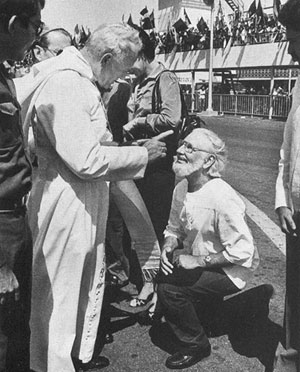
Image: Pope John Paul II reprimanding Father Ernesto Cardenal at Managua Airport for Cardenal’s support of “liberation theology” and his work with the Sandinista government.
It appears that Bergoglio, who was head of the Jesuit order in Buenos Aires during Argentina’s grim “dirty war,” mostly tended to his bureaucratic rise within the Church as Argentine security forces “disappeared” some 30,000 people for torture and murder from 1976 to 1983, including 150 Catholic priests suspected of believing in “liberation theology.”
Much as Pope Pius XII didn’t directly challenge the Nazis during the Holocaust, Father Bergoglio avoided any direct confrontation with the neo-Nazis who were terrorizing Argentina. Pope Francis’s defenders today, like apologists for Pope Pius, claim he did intervene quietly to save some individuals.
But no one asserts that Bergoglio stood up publicly against the “anticommunist” terror, as some other Church leaders did in Latin America, most notably El Salvador’s Archbishop Oscar Romero who then became a victim of right-wing assassins in 1980.
Indeed, the predominant role of the Church hierarchy – from the Vatican to the bishops in the individual countries – was to give political cover to the slaughter and to offer little protection to the priests and nuns who advocated “liberation theology,” i.e. the belief that Jesus did not just favor charity to the poor but wanted a just society that shared wealth and power with the poor.
In Latin America with its calcified class structure of a few oligarchs at one end and many peasants at the other, that meant reforms, such as land redistribution, literacy programs, health clinics, union rights, etc. But those changes were fiercely opposed by the local oligarchs and the multinational corporations that profited from the cheap labor and inequitable land distribution.
So, any reformers of any stripe were readily labeled “communists” and were made the targets of vicious security forces, often trained and indoctrinated by “anticommunist” military officers at the U.S.-run School of the Americas. The primary role of the Catholic hierarchy was to urge the people to stay calm and support the traditional system.
It is noteworthy that the orchestrated praise for Pope Francis in the U.S. news media has been to hail Bergoglio’s supposedly “humble” personality and his “commitment to the poor.” However, Bergoglio’s approach fits with the Church’s attitude for centuries, to give “charity” to the poor while doing little to change their cruel circumstances – as Church grandees hobnob with the rich and powerful.
Another Pope Favorite
Pope John Paul II, another favorite of the U.S. news media, shared this classic outlook. He emphasized conservative social issues, telling the faithful to forgo contraceptives, treating women as second-class Catholics and condemning homosexuality. He promoted charity for the poor and sometimes criticized excesses of capitalism, but he disdained leftist governments that sought serious economic reforms.
Elected in 1978, as right-wing “death squads” were gaining momentum across Latin America, John Paul II offered little protection to left-leaning priests and nuns who were targeted. He rebuffed Archbishop Romero’s plea to condemn El Salvador’s right-wing regime and its human rights violations. He stood by as priests were butchered and nuns were raped and killed.
Instead of leading the charge for real economic and political change in Latin America, John Paul II denounced “liberation theology.” During a 1983 trip to Nicaragua – then ruled by the leftist Sandinistas – the Pope condemned what he called the “popular Church” and would not let Ernesto Cardenal, a priest and a minister in the Sandinista government, kiss the papal ring. He also elevated clerics like Bergoglio who didn’t protest right-wing repression.
John Paul II appears to have gone even further, allowing the Catholic Church in Nicaragua to be used by the CIA and Ronald Reagan’s administration to finance and organize internal disruptions while the violent Nicaraguan Contras terrorized northern Nicaraguan towns with raids notorious for rape, torture and extrajudicial executions.
The Contras were originally organized by an Argentine intelligence unit that emerged from the country’s domestic “dirty war” and was taking its “anticommunist” crusade of terror across borders. After Reagan took office in 1981, he authorized the CIA to join with Argentine intelligence in expanding the Contras and their counterrevolutionary war.
A key part of Reagan’s Contra strategy was to persuade the American people and Congress that the Sandinistas represented a repressive communist dictatorship that persecuted the Catholic Church, aimed to create a “totalitarian dungeon,” and thus deserved violent overthrow.
A special office inside the National Security Council, headed by longtime CIA disinformation specialist Walter Raymond Jr., pushed these propaganda “themes” domestically. Raymond’s campaign exploited examples of tensions between the Catholic hierarchy and the Sandinista government as well as with La Prensa, the leading opposition newspaper.
To make the propaganda work with Americans, it was important to conceal the fact that elements of the Catholic hierarchy and La Prensa were being financed by the CIA and were coordinating with the Reagan administration’s destabilization strategies. [See Robert Parry’s Lost History.]
Evidence of Payments
In 1988, I discovered evidence of this reality while working as a correspondent for Newsweek magazine. At the time, the Iran-Contra scandal had undermined the case for spending more U.S. money to arm the Contras. But the Reagan administration continued to beat the propaganda drums by highlighting the supposed persecution of Nicaragua’s internal opposition.
To fend off U.S. hostility, which also included a harsh economic embargo, the Sandinistas announced increased political freedoms. But that represented only a new opportunity for Washington to orchestrate more political disruptions, which would either destabilize the government further or force a crackdown that could then be cited in seeking more Contra aid.
Putting the Sandinistas in this “inside-outside” vise had always been part of the CIA strategy, but with a crumbling economy and more U.S. money pouring into the opposition groups, the gambit was beginning to work.
Yet, it was crucial to the plan that the CIA’s covert relationship with Nicaragua’s internal opposition remain secret, not so much from the Sandinistas, who had detailed intelligence about this thoroughly penetrated operation, but from the American people. The U.S. public would get outraged at Sandinista reprisals against these “independent” groups only if the CIA’s hand were kept hidden.
A rich opportunity for the Reagan administration presented itself in summer 1988 when a new spasm of Contra ambushes killed 17 Nicaraguans and the anti-Sandinista internal opposition staged a violent demonstration in the town of Nandaime, a protest that Sandinista police dispersed with tear gas.
Reacting to the renewed violence, the Sandinistas closed down La Prensa and the Catholic Church’s radio station – both prime vehicles for anti-Sandinista propaganda. The Nicaraguan government also expelled U.S. Ambassador Richard Melton and seven other U.S. Embassy personnel for allegedly coordinating the disorders.
Major U.S. news outlets, which had accepted their role treating the Sandinistas as “designated enemies” of the United States, roared in outrage, and the U.S. Congress condemned the moves by a margin of 94-4 in the Senate and 385-18 in the House.
Melton then testified before the Senate Intelligence Committee first in secret and then in public, struggling to hide the open secret in Washington that Nicaragua’s internal opposition, like the Contras, was getting covert help from the U.S. government.
When asked by a senator in public session about covert American funding to the opposition, Melton dissembled awkwardly: “As to other activities that might be conducted, that’s – they were discussed – that would be discussed yesterday in the closed hearing.”
When pressed by Sen. Howard Metzenbaum on whether the embassy provided “encouragement – financial or otherwise – of dissident elements,” Melton responded stiffly: “The ambassador in any post is the principal representative of the U.S. government. And in that capacity, fulfills those functions.” He then declined to discuss “activities of an intelligence nature” in open session.
On the Payroll
In other words, yes, the U.S. government was covertly organizing and funding the activities of the supposedly “independent” internal opposition in Nicaragua. And, according to more than a dozen sources that I interviewed inside the Contra movement or close to U.S. intelligence, the Reagan administration had funneled CIA money to virtually every segment of the internal opposition, from the Catholic Church to La Prensa to business and labor groups to political parties.
“We’ve always had the internal opposition on the CIA payroll,” one U.S. government official said. The CIA’s budget line for Nicaraguan political action – separate from Contra military operations – was about $10 million a year, my sources said. I learned that the CIA had been using the Church and Cardinal Miguel Obando y Bravo to funnel money into Nicaragua.
Obando was a plodding but somewhat complex character. In the 1970s, he had criticized the repression of the Somoza dictatorship and expressed some sympathy for the young Sandinista revolutionaries who were trying to bring social and economic changes to Nicaragua.
However, after the murder of El Salvador’s Archbishop Romero in 1980 and Pope John Paul II’s repudiation of “liberation theology,” Obando shifted clumsily into the anti-Sandinista camp, attacking the “people’s church” and accusing the Sandinistas of “godless communism.”
On May 25, 1985, he was rewarded when the Pope named him Cardinal for Central America. Then, despite mounting evidence of Contra atrocities, Obando traveled to the United States in January 1986 and threw his support behind a renewal of military aid to the Contras.
All this made a lot more sense after factoring in that Obando had essentially been put onto the CIA’s payroll. The CIA funding for Nicaragua’s Catholic Church was originally unearthed in 1985 by the congressional intelligence oversight committees, which then insisted that the money be cut off to avoid compromising Obando further.
But the funding was simply transferred to another secret operation headed by White House aide Oliver North. In fall 1985, North earmarked $100,000 of his privately raised money to go to Obando for his anti-Sandinista activities, I learned from my sources.
I was also told that the CIA’s support for Obando and the Catholic hierarchy went through a maze of cut-outs in Europe, apparently to give Obando deniability. But one well-placed Nicaraguan exile said he had spoken with Obando about the money and the Cardinal had expressed fear that his past receipt of CIA funding would come out.
What to Do?
Discovering this CIA funding of Nicaragua’s Catholic Church presented professional problems for me at Newsweek, where my senior editors were already making clear that they sympathized with the Reagan administration’s muscular foreign policy and felt that the Iran-Contra scandal had gone too far in undermining U.S. interests.
But what was the right thing for an American journalist to do with this information? Here was a case in which the U.S. government was misleading the American public by pretending that the Sandinistas were cracking down on the Catholic Church and the internal opposition without any justification. Plus, this U.S. propaganda was being used to make the case in Congress for an expanded war in which thousands of Nicaraguans were dying.
However, if Newsweek ran the story, it would put CIA assets, including Cardinal Obando, in a dicey situation, possibly even life-threatening. So, when I presented the information to my bureau chief, Evan Thomas, I made no recommendation on whether we should publish or not. I just laid out the facts as I had ascertained them. To my surprise, Thomas was eager to go forward.
Newsweek contacted its Central America correspondent Joseph Contreras, who outlined our questions to Obando’s aides and prepared a list of questions to present to the Cardinal personally. However, when Contreras went to Obando’s home in a posh suburb of Managua, the Cardinal literally evaded the issue.
As Contreras later recounted in a cable back to Newsweek in the United States, he was approaching the front gate when it suddenly swung open and the Cardinal, sitting in the front seat of his burgundy Toyota Land Cruiser, blew past.
As Contreras made eye contact and waved the letter, Obando’s driver gunned the engine. Contreras jumped into his car and hastily followed. Contreras guessed correctly that Obando had turned left at one intersection and headed north toward Managua.
Contreras caught up to the Cardinal’s vehicle at the first stop-light. The driver apparently spotted the reporter and, when the light changed, sped away, veering from lane to lane. The Land Cruiser again disappeared from view, but at the next intersection, Contreras turned right and spotted the car pulled over, with its occupants presumably hoping that Contreras had turned left.
Quickly, the Cardinal’s vehicle pulled onto the road and now sped back toward Obando’s house. Contreras gave up the chase, fearing that any further pursuit might appear to be harassment. Several days later, having regained his composure, the Cardinal finally met with Contreras and denied receiving any CIA money. But Contreras told me that Obando’s denial was unconvincing.
Newsweek drafted a version of the story, making it appear as if we weren’t sure of the facts about Obando and the money. When I saw a “readback” of the article, I went into Thomas’s office and said that if Newsweek didn’t trust my reporting, we shouldn’t run the story at all. He said that wasn’t the case; it was just that the senior editors felt more comfortable with a vaguely worded story.
Hot Water
We ended up in hot water with the Reagan administration and right-wing media attack groups anyway. Accuracy in Media lambasted me, in particular, for going with such a sensitive story without being sure of the facts (which, of course, I was).
Thomas was summoned to the State Department where Assistant Secretary of State Elliott Abrams heaped more criticism on me though not denying the facts of our story. Newsweek also agreed, in the face of right-wing pressure, to subject me and the article to an internal investigation, which quietly reconfirmed the facts of the story.
Despite this corroboration, the incident damaged my relations with senior Newsweek editors, particularly executive editor Maynard Parker who saw himself as part of the New York/Washington foreign policy establishment and was deeply hostile to the Iran-Contra scandal, which I had helped expose.
As for Obando, the Sandinistas did nothing to punish him for his collaboration with the CIA and he gradually evolved more into a figure of reconciliation than confrontation. However, the hyper-secretive Vatican has refused to open its archives for any serious research into its relationship with the CIA and other Western intelligence services.
Whenever allegations do arise about the Catholic Church’s hierarchy winking and nodding at the kinds of human rights atrocities that claimed hundreds of thousands of lives in Latin America during the 1970s and 1980s, the Vatican PR department lashes out with sternly worded denials.
That practice is playing out again in the days after the election of Pope Francis I. Rather than a serious and reflective assessment of the actions (and inactions) of Cardinal Bergoglio, Cardinal Obando, Pope John Paul II and other Church leaders during those dark days of torture and murder, the Vatican simply denounces all allegations as “slander,” “calumny” and politically motivated lies.
Investigative reporter Robert Parry broke many of the Iran-Contra stories for The Associated Press and Newsweek in the 1980s. You can buy his new book, America’s Stolen Narrative, either in print here or as an e-book (from Amazon and barnesandnoble.com).
The election of Argentine Cardinal Jorge Bergoglio as Pope Francis brings back into focus the troubling role of the Catholic hierarchy in blessing much of the brutal repression that swept Latin America in the 1970s and 1980s, killing and torturing tens of thousands of people including priests and nuns accused of sympathizing with leftists.
The Vatican’s fiercely defensive reaction to the reemergence of these questions as they relate to the new Pope also is reminiscent of the pattern of deceptive denials that became another hallmark of that era when propaganda was viewed as an integral part of the “anticommunist” struggles, which were often supported financially and militarily by the U.S. Central Intelligence Agency.

Image: Pope John Paul II reprimanding Father Ernesto Cardenal at Managua Airport for Cardenal’s support of “liberation theology” and his work with the Sandinista government.
It appears that Bergoglio, who was head of the Jesuit order in Buenos Aires during Argentina’s grim “dirty war,” mostly tended to his bureaucratic rise within the Church as Argentine security forces “disappeared” some 30,000 people for torture and murder from 1976 to 1983, including 150 Catholic priests suspected of believing in “liberation theology.”
Much as Pope Pius XII didn’t directly challenge the Nazis during the Holocaust, Father Bergoglio avoided any direct confrontation with the neo-Nazis who were terrorizing Argentina. Pope Francis’s defenders today, like apologists for Pope Pius, claim he did intervene quietly to save some individuals.
But no one asserts that Bergoglio stood up publicly against the “anticommunist” terror, as some other Church leaders did in Latin America, most notably El Salvador’s Archbishop Oscar Romero who then became a victim of right-wing assassins in 1980.
Indeed, the predominant role of the Church hierarchy – from the Vatican to the bishops in the individual countries – was to give political cover to the slaughter and to offer little protection to the priests and nuns who advocated “liberation theology,” i.e. the belief that Jesus did not just favor charity to the poor but wanted a just society that shared wealth and power with the poor.
In Latin America with its calcified class structure of a few oligarchs at one end and many peasants at the other, that meant reforms, such as land redistribution, literacy programs, health clinics, union rights, etc. But those changes were fiercely opposed by the local oligarchs and the multinational corporations that profited from the cheap labor and inequitable land distribution.
So, any reformers of any stripe were readily labeled “communists” and were made the targets of vicious security forces, often trained and indoctrinated by “anticommunist” military officers at the U.S.-run School of the Americas. The primary role of the Catholic hierarchy was to urge the people to stay calm and support the traditional system.
It is noteworthy that the orchestrated praise for Pope Francis in the U.S. news media has been to hail Bergoglio’s supposedly “humble” personality and his “commitment to the poor.” However, Bergoglio’s approach fits with the Church’s attitude for centuries, to give “charity” to the poor while doing little to change their cruel circumstances – as Church grandees hobnob with the rich and powerful.
Another Pope Favorite
Pope John Paul II, another favorite of the U.S. news media, shared this classic outlook. He emphasized conservative social issues, telling the faithful to forgo contraceptives, treating women as second-class Catholics and condemning homosexuality. He promoted charity for the poor and sometimes criticized excesses of capitalism, but he disdained leftist governments that sought serious economic reforms.
Elected in 1978, as right-wing “death squads” were gaining momentum across Latin America, John Paul II offered little protection to left-leaning priests and nuns who were targeted. He rebuffed Archbishop Romero’s plea to condemn El Salvador’s right-wing regime and its human rights violations. He stood by as priests were butchered and nuns were raped and killed.
Instead of leading the charge for real economic and political change in Latin America, John Paul II denounced “liberation theology.” During a 1983 trip to Nicaragua – then ruled by the leftist Sandinistas – the Pope condemned what he called the “popular Church” and would not let Ernesto Cardenal, a priest and a minister in the Sandinista government, kiss the papal ring. He also elevated clerics like Bergoglio who didn’t protest right-wing repression.
John Paul II appears to have gone even further, allowing the Catholic Church in Nicaragua to be used by the CIA and Ronald Reagan’s administration to finance and organize internal disruptions while the violent Nicaraguan Contras terrorized northern Nicaraguan towns with raids notorious for rape, torture and extrajudicial executions.
The Contras were originally organized by an Argentine intelligence unit that emerged from the country’s domestic “dirty war” and was taking its “anticommunist” crusade of terror across borders. After Reagan took office in 1981, he authorized the CIA to join with Argentine intelligence in expanding the Contras and their counterrevolutionary war.
A key part of Reagan’s Contra strategy was to persuade the American people and Congress that the Sandinistas represented a repressive communist dictatorship that persecuted the Catholic Church, aimed to create a “totalitarian dungeon,” and thus deserved violent overthrow.
A special office inside the National Security Council, headed by longtime CIA disinformation specialist Walter Raymond Jr., pushed these propaganda “themes” domestically. Raymond’s campaign exploited examples of tensions between the Catholic hierarchy and the Sandinista government as well as with La Prensa, the leading opposition newspaper.
To make the propaganda work with Americans, it was important to conceal the fact that elements of the Catholic hierarchy and La Prensa were being financed by the CIA and were coordinating with the Reagan administration’s destabilization strategies. [See Robert Parry’s Lost History.]
Evidence of Payments
In 1988, I discovered evidence of this reality while working as a correspondent for Newsweek magazine. At the time, the Iran-Contra scandal had undermined the case for spending more U.S. money to arm the Contras. But the Reagan administration continued to beat the propaganda drums by highlighting the supposed persecution of Nicaragua’s internal opposition.
To fend off U.S. hostility, which also included a harsh economic embargo, the Sandinistas announced increased political freedoms. But that represented only a new opportunity for Washington to orchestrate more political disruptions, which would either destabilize the government further or force a crackdown that could then be cited in seeking more Contra aid.
Putting the Sandinistas in this “inside-outside” vise had always been part of the CIA strategy, but with a crumbling economy and more U.S. money pouring into the opposition groups, the gambit was beginning to work.
Yet, it was crucial to the plan that the CIA’s covert relationship with Nicaragua’s internal opposition remain secret, not so much from the Sandinistas, who had detailed intelligence about this thoroughly penetrated operation, but from the American people. The U.S. public would get outraged at Sandinista reprisals against these “independent” groups only if the CIA’s hand were kept hidden.
A rich opportunity for the Reagan administration presented itself in summer 1988 when a new spasm of Contra ambushes killed 17 Nicaraguans and the anti-Sandinista internal opposition staged a violent demonstration in the town of Nandaime, a protest that Sandinista police dispersed with tear gas.
Reacting to the renewed violence, the Sandinistas closed down La Prensa and the Catholic Church’s radio station – both prime vehicles for anti-Sandinista propaganda. The Nicaraguan government also expelled U.S. Ambassador Richard Melton and seven other U.S. Embassy personnel for allegedly coordinating the disorders.
Major U.S. news outlets, which had accepted their role treating the Sandinistas as “designated enemies” of the United States, roared in outrage, and the U.S. Congress condemned the moves by a margin of 94-4 in the Senate and 385-18 in the House.
Melton then testified before the Senate Intelligence Committee first in secret and then in public, struggling to hide the open secret in Washington that Nicaragua’s internal opposition, like the Contras, was getting covert help from the U.S. government.
When asked by a senator in public session about covert American funding to the opposition, Melton dissembled awkwardly: “As to other activities that might be conducted, that’s – they were discussed – that would be discussed yesterday in the closed hearing.”
When pressed by Sen. Howard Metzenbaum on whether the embassy provided “encouragement – financial or otherwise – of dissident elements,” Melton responded stiffly: “The ambassador in any post is the principal representative of the U.S. government. And in that capacity, fulfills those functions.” He then declined to discuss “activities of an intelligence nature” in open session.
On the Payroll
In other words, yes, the U.S. government was covertly organizing and funding the activities of the supposedly “independent” internal opposition in Nicaragua. And, according to more than a dozen sources that I interviewed inside the Contra movement or close to U.S. intelligence, the Reagan administration had funneled CIA money to virtually every segment of the internal opposition, from the Catholic Church to La Prensa to business and labor groups to political parties.
“We’ve always had the internal opposition on the CIA payroll,” one U.S. government official said. The CIA’s budget line for Nicaraguan political action – separate from Contra military operations – was about $10 million a year, my sources said. I learned that the CIA had been using the Church and Cardinal Miguel Obando y Bravo to funnel money into Nicaragua.
Obando was a plodding but somewhat complex character. In the 1970s, he had criticized the repression of the Somoza dictatorship and expressed some sympathy for the young Sandinista revolutionaries who were trying to bring social and economic changes to Nicaragua.
However, after the murder of El Salvador’s Archbishop Romero in 1980 and Pope John Paul II’s repudiation of “liberation theology,” Obando shifted clumsily into the anti-Sandinista camp, attacking the “people’s church” and accusing the Sandinistas of “godless communism.”
On May 25, 1985, he was rewarded when the Pope named him Cardinal for Central America. Then, despite mounting evidence of Contra atrocities, Obando traveled to the United States in January 1986 and threw his support behind a renewal of military aid to the Contras.
All this made a lot more sense after factoring in that Obando had essentially been put onto the CIA’s payroll. The CIA funding for Nicaragua’s Catholic Church was originally unearthed in 1985 by the congressional intelligence oversight committees, which then insisted that the money be cut off to avoid compromising Obando further.
But the funding was simply transferred to another secret operation headed by White House aide Oliver North. In fall 1985, North earmarked $100,000 of his privately raised money to go to Obando for his anti-Sandinista activities, I learned from my sources.
I was also told that the CIA’s support for Obando and the Catholic hierarchy went through a maze of cut-outs in Europe, apparently to give Obando deniability. But one well-placed Nicaraguan exile said he had spoken with Obando about the money and the Cardinal had expressed fear that his past receipt of CIA funding would come out.
What to Do?
Discovering this CIA funding of Nicaragua’s Catholic Church presented professional problems for me at Newsweek, where my senior editors were already making clear that they sympathized with the Reagan administration’s muscular foreign policy and felt that the Iran-Contra scandal had gone too far in undermining U.S. interests.
But what was the right thing for an American journalist to do with this information? Here was a case in which the U.S. government was misleading the American public by pretending that the Sandinistas were cracking down on the Catholic Church and the internal opposition without any justification. Plus, this U.S. propaganda was being used to make the case in Congress for an expanded war in which thousands of Nicaraguans were dying.
However, if Newsweek ran the story, it would put CIA assets, including Cardinal Obando, in a dicey situation, possibly even life-threatening. So, when I presented the information to my bureau chief, Evan Thomas, I made no recommendation on whether we should publish or not. I just laid out the facts as I had ascertained them. To my surprise, Thomas was eager to go forward.
Newsweek contacted its Central America correspondent Joseph Contreras, who outlined our questions to Obando’s aides and prepared a list of questions to present to the Cardinal personally. However, when Contreras went to Obando’s home in a posh suburb of Managua, the Cardinal literally evaded the issue.
As Contreras later recounted in a cable back to Newsweek in the United States, he was approaching the front gate when it suddenly swung open and the Cardinal, sitting in the front seat of his burgundy Toyota Land Cruiser, blew past.
As Contreras made eye contact and waved the letter, Obando’s driver gunned the engine. Contreras jumped into his car and hastily followed. Contreras guessed correctly that Obando had turned left at one intersection and headed north toward Managua.
Contreras caught up to the Cardinal’s vehicle at the first stop-light. The driver apparently spotted the reporter and, when the light changed, sped away, veering from lane to lane. The Land Cruiser again disappeared from view, but at the next intersection, Contreras turned right and spotted the car pulled over, with its occupants presumably hoping that Contreras had turned left.
Quickly, the Cardinal’s vehicle pulled onto the road and now sped back toward Obando’s house. Contreras gave up the chase, fearing that any further pursuit might appear to be harassment. Several days later, having regained his composure, the Cardinal finally met with Contreras and denied receiving any CIA money. But Contreras told me that Obando’s denial was unconvincing.
Newsweek drafted a version of the story, making it appear as if we weren’t sure of the facts about Obando and the money. When I saw a “readback” of the article, I went into Thomas’s office and said that if Newsweek didn’t trust my reporting, we shouldn’t run the story at all. He said that wasn’t the case; it was just that the senior editors felt more comfortable with a vaguely worded story.
Hot Water
We ended up in hot water with the Reagan administration and right-wing media attack groups anyway. Accuracy in Media lambasted me, in particular, for going with such a sensitive story without being sure of the facts (which, of course, I was).
Thomas was summoned to the State Department where Assistant Secretary of State Elliott Abrams heaped more criticism on me though not denying the facts of our story. Newsweek also agreed, in the face of right-wing pressure, to subject me and the article to an internal investigation, which quietly reconfirmed the facts of the story.
Despite this corroboration, the incident damaged my relations with senior Newsweek editors, particularly executive editor Maynard Parker who saw himself as part of the New York/Washington foreign policy establishment and was deeply hostile to the Iran-Contra scandal, which I had helped expose.
As for Obando, the Sandinistas did nothing to punish him for his collaboration with the CIA and he gradually evolved more into a figure of reconciliation than confrontation. However, the hyper-secretive Vatican has refused to open its archives for any serious research into its relationship with the CIA and other Western intelligence services.
Whenever allegations do arise about the Catholic Church’s hierarchy winking and nodding at the kinds of human rights atrocities that claimed hundreds of thousands of lives in Latin America during the 1970s and 1980s, the Vatican PR department lashes out with sternly worded denials.
That practice is playing out again in the days after the election of Pope Francis I. Rather than a serious and reflective assessment of the actions (and inactions) of Cardinal Bergoglio, Cardinal Obando, Pope John Paul II and other Church leaders during those dark days of torture and murder, the Vatican simply denounces all allegations as “slander,” “calumny” and politically motivated lies.
Investigative reporter Robert Parry broke many of the Iran-Contra stories for The Associated Press and Newsweek in the 1980s. You can buy his new book, America’s Stolen Narrative, either in print here or as an e-book (from Amazon and barnesandnoble.com).