Ipinapakita ang mga post na may etiketa na death. Ipakita ang lahat ng mga post

Sabado, Nobyembre 16, 2013

ANG LOCAL GOVERNMENT PO MAY KASALANAN

"the local government was first in line. . . . but . . .i guess they were not prepared . .as they were supposed to be the first responders . . . . .blah . . blah . . .blah . . ."
                            "Yeah, right."

Biyernes, Setyembre 20, 2013

DECEITFUL JESUITS

Washington’s Pope”? Who is Pope Francis I? Cardinal Jorge Mario Bergoglio and Argentina’s “Dirty War”


The Vatican conclave has elected Cardinal Jorge Mario Bergoglio as Pope Francis I
Who is Jorge Mario Bergoglio? 
In 1973, he had been appointed “Provincial” of Argentina for the Society of Jesus.
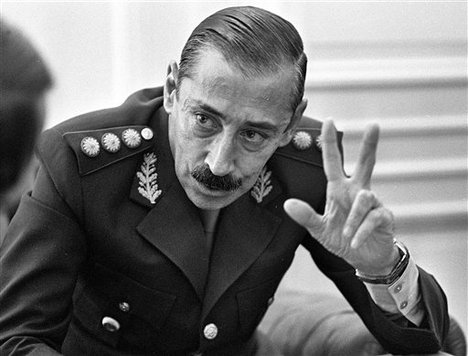
In this capacity, Bergoglio was the highest ranking Jesuit in Argentina during the military dictatorship led by General Jorge Videla (1976-1983).
He later became bishop and archbishop of Buenos Aires. Pope John Paul II elevated him to the title of cardinal in 2001
When the military junta relinquished power in 1983, the duly elected president Raúl Alfonsín set up a Truth Commission pertaining to the crimes underlying the “Dirty War” (La Guerra Sucia).
The military junta had been supported covertly by Washington.
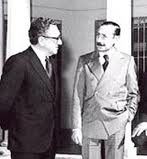
US. Secretary of State Henry Kissinger played a behind the scenes role in the 1976 military coup.
Kissinger’s top deputy on Latin America, William Rogers, told him two days after the coup that “we’ve got to expect a fair amount of repression, probably a good deal of blood, in Argentina before too long.” … (National Security Archive, March 23, 2006)

“Operation Condor”
Ironically, a major trial opened up in Buenos Aires on March 5, 2013 a week prior to Cardinal Bergoglio’s investiture as Pontiff. The ongoing trial in Buenos Aires is: “to consider the totality of crimes carried out under Operation Condor, a coordinated campaign by various US-backed Latin American dictatorships in the 1970s and 1980s to hunt down, torture and murder tens of thousands of opponents of those regimes.”
For further details, see Operation Condor: Trial On Latin American Rendition And Assassination Program By Carlos Osorio and Peter Kornbluh, March 10, 2013
(Photo above: Henry Kissinger and General Jorge Videla (1970s)

The military junta led by General Jorge Videla (left) was responsible for countless assassinations, including priests and nuns who opposed military rule following the CIA sponsored March 24, 1976 coup which overthrew the government of Isabel Peron:
 ”Videla was among the generals convicted of human rights crimes, including “disappearances”, torture, murders and kidnappings. In 1985, Videla was sentenced to life imprisonment at the military prison of Magdalena.”
Wall Street and the Neoliberal Economic Agenda
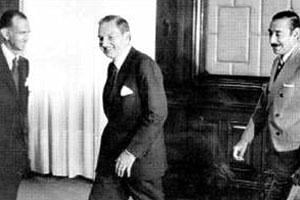
One of the key appointments of the military junta (on the instructions of Wall Street) was the Minister of Economy, Jose Alfredo Martinez de Hoz, a member of Argentina’s business establishment and a close friend of David Rockefeller.
The neoliberal macro-economic policy package adopted under Martinez de Hoz was a “carbon copy” of that imposed in October 1973 in Chile by the Pinochet dictatorship under advice from the  “Chicago Boys”, following the September 11, 1973 coup d’Etat and the assassination of president Salvador Allende.
Wages were immediately frozen by decree. Real purchasing power collapsed by more than 30 percent in the 3 months following the March 24, 1976 military coup. (Author’s estimates, Cordoba, Argentina, July 1976). The Argentinean population was impoverished.
Under the helm of Minister of Economy Jose Alfredo Martinez de Hoz, central bank monetary policy was largely determined by Wall Street and the IMF. The currency market was manipulated. The Peso was deliberately overvalued leading to an insurmountable external debt. The entire national economy was precipitated into bankruptcy.
(See Image right: From left to right: Jose Alfredo Martinez de Hoz, David Rockefeller and General Jorge Videla)
Wall Street and the Catholic Church Hierarchy
Wall Street was firmly behind the military Junta which waged “The Dirty War” on its behalf. In turn, the Catholic Church hierarchy played a central role in sustaining the legitimacy of the military Junta.
The Order of Jesus –which represented the Conservative yet most influential faction within the Catholic Church, closely associated with Argentina’s economic elites– was firmly behind the military Junta, against so-called “Leftists” in the Peronista movement.
“The Dirty War”: Allegations directed Against Cardinal Jorge Mario Bergoglio

Condemning the military dictatorship (including its human rights violations) was a taboo within the Catholic Church.  While the upper echelons of the Church were supportive of the military Junta, the grassroots of the Church was firmly opposed to the imposition of military rule.
In 2005, human rights lawyer Myriam Bregman filed a criminal suit against Cardinal Jorge Bergoglio, accusing him of conspiring with the military junta in the 1976 kidnapping of two Jesuit priests.
Several years later, the survivors of the “Dirty War” openly accused Cardinal Jorge Bergoglio of complicity in the kidnapping of  priests Francisco Jalics y Orlando Yorio as well six members of their parish,  (El Mundo, 8 November 2010)
(Image Left: Jorge Mario Bergoglio and General Jorge Videla)
Bergoglio, who at the time was “Provincial” for the Society of Jesus, had ordered the two “Leftist” Jesuit priests and opponents of military rule  “to leave their pastoral work” (i.e. they were fired) following divisions within the Society of Jesus regarding the role of the Catholic Church and its relations to the military Junta.
While the two priests Francisco Jalics y Orlando Yorio, kidnapped by the death squads in May 1976 were released five months later. after having been tortured, six other people associated with their parish kidnapped as part of the same operation were “disappeared” (desaparecidos). These included four teachers associated with the parish and two of their husbands.
Upon his release, Priest Orlando Yorio “accused Bergoglio of effectively handing them over [including six other people] to the death squads … Jalics refused to discuss the complaint after moving into seclusion in a German monastery.” (Associated Press, March 13, 2013, emphasis added),
“During the first trial of leaders of the military junta in 1985, Yorio declared, “I am sure that he himself gave over the list with our names to the Navy.” The two were taken to the notorious Navy School of Mechanics (ESMA) torture center and held for over five months before being drugged and dumped in a town outside the city. (See Bill van Auken, “The Dirty War” Pope, World Socialist Website and Global Research, March 14, 2013
Among those “disappeared” by the death squads were Mónica Candelaria Mignone and María Marta Vázquez Ocampo, respectively daughter of the founder of of the CELS (Centro de Estudios Legales y Sociales) Emilio Mignone and daughter of the president of Madres de Plaza de Mayo, Martha Ocampo de Vázquez. (El Periodista Online, March 2013).
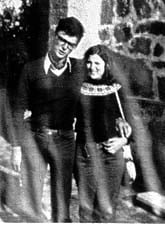
María Marta Vásquez, her husband César Lugones (see picture right) and Mónica Candelaria Mignone allegedly “handed over to the death squads” by Jesuit “Provincial” Jorge Mario Bergoglio are among the thousands of “desaparecidos” (disappeared) of Argentina’s “Dirty War”, which was supported covertly by Washington under “Operation Condor”. (See memorialmagro.com.ar)
In the course of the trial initiated in 2005:
“Bergoglio [Pope Francis I] twice invoked his right under Argentine law to refuse to appear in open court, and when he eventually did testify in 2010, his answers were evasive”: “At least two cases directly involved Bergoglio. One examined the torture of two of his Jesuit priests — Orlando Yorio and Francisco Jalics — who were kidnapped in 1976 from the slums where they advocated liberation theology. Yorio accused Bergoglio of effectively handing them over to the death squads… by declining to tell the regime that he endorsed their work. Jalics refused to discuss it after moving into seclusion in a German monastery.” (Los Angeles Times, April 1, 2005)
The Secret Memorandum
[This section was added on March 19, 2013]
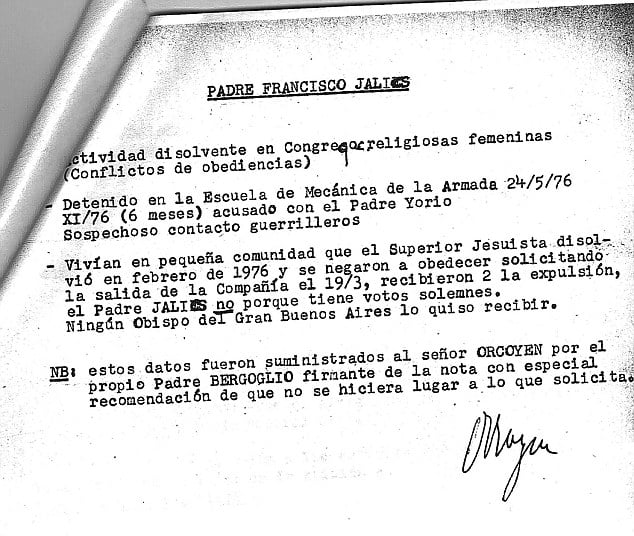
The military government acknowledged in a Secret Memo (see below) that Father Bergoglio had accused the two priests of having established contacts with the guerilleros, and for having disobeyed the orders of the Church hierarchy (Conflictos de obedecencia). It also states that the Jesuit order had demanded the dissolution of  their group and that they had refused to abide by Bergoglio’s instructions.
The document acknowledges that the “arrest” of the two priests, who were taken to the torture and detention center at the Naval School of Mechanics, ESMA, was based on information transmitted by Father Bergoglio to the military authorities. (signed by Mr. Orcoyen)
(see below).
While a former member of  the priests group had joined the insurgency, there was no evidence of the priests having contacts with the guerrilla movement.
“Holy Communion for the Dictators” 
The accusations directed against Bergoglio regarding the two kidnapped Jesuit priests and six members of their parish are but the tip of the iceberg. While Bergoglio was an important figure in the Catholic Church,  he was certainly not alone in supporting the Military Junta.
According to lawyer Myriam Bregman:  “Bergoglio’s own statements proved church officials knew from early on that the junta was torturing and killing its citizens”, and yet publicly endorsed the dictators. “The dictatorship could not have operated this way without this key support,” (Los Angeles Times, April 1, 2005 emphasis added)
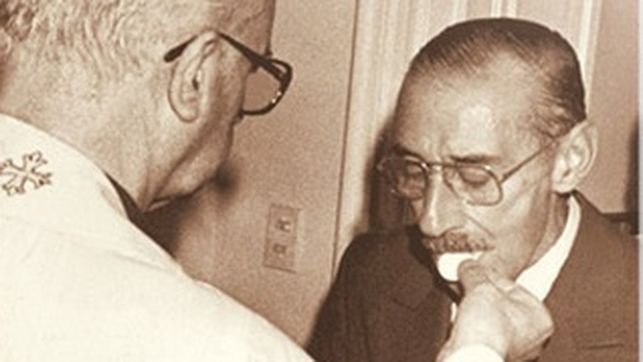
(Image right: General Jorge Videla takes communion. Date and name of priest unconfirmed)
The entire Catholic hierarchy was behind the US sponsored military dictatorship.  It is worth recalling that on March 23, 1976, on the eve of the military coup:
“Videla and other plotters received the blessing of the Archbishop of Paraná, Adolfo Tortolo, who also served as vicar of the armed forces. The day of the takeover itself, the military leaders had a lengthy meeting with the leaders of the bishop’s conference. As he emerged from that meeting, Archbishop Tortolo stated that although “the church has its own specific mission . . . there are circumstances in which it cannot refrain from participating even when it is a matter of problems related to the specific order of the state.” He urged Argentinians to “cooperate in a positive way” with the new government.” (The Humanist.org, January 2011, emphasis added)
In an interview conducted with El Sur, General Jorge Videla, who is now serving a life sentence for crimes against humanity confirmed that:
“He kept the country’s Catholic hierarchy informed about his regime’s policy of “disappearing” political opponents, and that Catholic leaders offered advice on how to “manage” the policy. 
Jorge Videla said he had “many conversations” with Argentina’s primate, Cardinal Raúl Francisco Primatesta, about his regime’s dirty war against left-wing activists. He said there were also conversations with other leading bishops from Argentina’s episcopal conference as well as with the country’s papal nuncio at the time, Pio Laghi.
“They advised us about the manner in which to deal with the situation,” said Videla” (Tom Henningan, Former Argentinian dictator says he told Catholic Church of disappeared,  Irish Times, July 24, 2012, emphasis added)
It is worth noting that according to a 1976 statement by Archbishop Adolfo Tortolo, the military would always consult with a member of the Catholic hierarchy in the case of the “arrest” of a grassroots member of  the clergy. This statement was made specifically in relation to the two kidnapped Jesuit priests, whose pastoral activities were under the authority of Society of Jesus “provincial” Jorge Mario Bergoglio. (El Periodista Online, March 2013).
In endorsing the military Junta, the Catholic hierarchy was complicit in torture and mass killings, an estimated “22,000 dead and disappeared, from 1976 to  1978  … Thousands of additional victims were killed between 1978 and 1983 when the military was forced from power.” (National Security Archive, March 23, 2006).
The Role of the Vatican

The Vatican under Pope Paul VI and Pope John Paul II played a central  role in supporting the Argentinian military Junta.
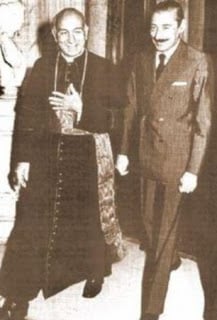
Pio Laghi, the Vatican’s apostolic nuncio to Argentina admitted “turning a blind eye” to the torture and massacres.
Laghi had personal ties to members of the ruling military junta including  General Jorge Videla and Admiral Emilio Eduardo Massera.
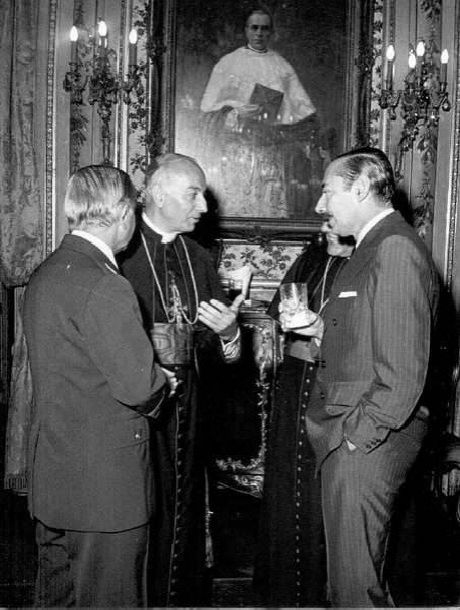
(See image left. Vatican’s Nuncio Pio Laghi and General Jorge Videla)
Admiral Emilio Massera in close liaison with his US handlers, was the mastermind of “La Guerra Sucia” (The Dirty War). Under the auspices of the military regime, he established:
“an interrogation and torture centre in the Naval School of Mechanics, ESMA [close to Buenos Aires], … It was a sophisticated, multi-purpose establishment, vital in the military plan to assassinate an estimated 30,000 “enemies of the state”. …  Many thousands of ESMA’s inmates, including, for instance, two French nuns, were routinely tortured mercilessly before being killed or dropped from aircraft into the River Plata.
Massera, the most forceful member of the triumvirate, did his best to maintain his links with Washington. He assisted in the development of Plan Cóndor, a collaborative scheme to co-ordinate the terrorism being practised by South American military régimes. (Hugh O’Shaughnessy, Admiral Emilio Massera: Naval officer who took part in the 1976 coup in Argentina and was later jailed for his part in the junta’s crimes, The Independent, November 10, 2010, emphasis added)
The Catholic Church: Chile versus Argentina
It is worth noting that  in the wake of the military coup in Chile on September 11,1973, the Cardinal of Santiago de Chile, Raul Silva Henriquez openly condemned the military junta led by General Augusto Pinochet. In marked contrast to Argentina, this stance of the Catholic hierarchy in Chile was instrumental in curbing the tide of political assassinations and human rights violations directed against supporters of Salvador Allende  and opponents of the military regime.
The man behind the interfaith Comité Pro-Paz was Cardinal Raúl Silva Henríquez. Shortly after the coup, Silva, … stepped into the role of “upstander,”a term the author and activist Samantha Power coined to distinguish people who stand up to injustice—often at great personal risk—from “bystanders.”
… Soon after the coup, Silva and other church leaders published a declaration condemning and expressing sorrow for the bloodshed. This was a fundamental turning point for many members of the Chilean clergy… The cardinal visited the National Stadium and, shocked by the scale of the government crackdown, instructed his aides to begin collecting information from the thousands flocking to the church for refuge.
Silva’s actions led to an open conflict with Pinochet, who did not hesitate to threaten the church and the Comité  Pro-Paz. (Taking a Stand Against Pinochet: The Catholic Church and the Disappeared pdf)
Had the Catholic hierarchy in Argentina  and Jorge Mario Bergoglio taken a similar stance to that of Cardinal Raul Silva Henriquez, thousands of lives would have been saved.
Jorge Mario Bergoglio was not, in the words of Samantha Powers, a “bystander”. He was complicit in extensive crimes against humanity.
Neither is Pope Francis “a Man of the People” committed to “helping the poor” in the footsteps of Saint Francis of Assisi, as portrayed in chorus by the Western media mantra. Quite the opposite: his endeavors under the military Junta, consistently targeted progressive members of the Catholic clergy as well as committed human rights activists involved in grassroots anti-poverty programs.
In supporting Argentina’s “Dirty War”, Jorge Mario Bergoglio has blatantly violated the very tenets of Christian morality which cherish  the value of human life.  Author’s message to Pope Francis: “Thou shalt not kill”
“Operation Condor” and the Catholic Church
The election of Cardinal Bergoglio by the Vatican conclave to serve as Pope Francis I will have immediate repercussions regarding the ongoing “Operation Condor” Trial in Buenos Aires.
The Church was involved in supporting the military Junta.  This is something which will emerge in the course of the trial proceedings.  No doubt, there will be attempts to obfuscate the role of the Catholic hierarchy and the newly appointed Pope Francis I,  who served as head of Argentina’s Jesuit order during the military dictatorship.
Jorge Mario Bergoglio:  “Washington’s Pope in the Vatican”? 
The election of Pope Francis I has broad geopolitical implications for the entire Latin American  region.
In the 1970s, Jorge Mario Bergoglio was supportive of a US sponsored military dictatorship.
The Catholic hierarchy in Argentina supported the military government. The Junta’s program of torture, assassinations and ‘disappearances” of thousands of political opponents was coordinated and supported by Washington under the CIA’s “Operation Condor”.
Wall Street’s interests were sustained through Jose Alfredo Martinez de Hoz’ office at the Ministry of Economy.
The Catholic Church in Latin America is politically influential. It also has a grip on public opinion. This is known and understood by the architects of US foreign policy as well as US intelligence.
In Latin America, where a number of governments are now challenging US hegemony, one would expect –given Bergoglio’s track record–  that the new Pontiff Francis I as leader of the Catholic Church, will play de facto, a discrete “undercover” political role on behalf of Washington.
With Jorge Bergoglio, Pope Francis I  in the Vatican –who faithfully served US interests in the heyday of General Jorge Videla and Admiral Emilio Massera–  the hierarchy of the Catholic Church in Latin America can once again be effectively manipulated to undermine “progressive” (Leftist) governments, not only in Argentina (in relation to the government of Cristina Kirschner) but throughout the entire region, including Venezuela, Ecuador and Bolivia.
The instatement of  “a pro-US pope” occurred a week following the death of  president Hugo Chavez.
“Regime Change” at the Vatican

The US State Department routinely pressures members of the United Security Council with a view to influencing the vote pertaining to Security Council resolutions.
US covert operations and propaganda campaigns are routinely applied with a view to influencing national elections in different countries around the World.
Similarly, the CIA has a longstanding covert relationship with the Vatican.
Did the US government attempt to influence the outcome of the election of the new pontiff?
Firmly committed to serving US foreign policy interests in Latin America, Jorge Mario Bergoglio was Washington’s preferred candidate.
Were undercover pressures discretely exerted by Washington, within the Catholic Church, directly or indirectly, on the 115 cardinals who are members of the Vatican conclave?

POPE FRANCIS IS A DANGEROUS MAN.

Pope Francis, CIA and ‘Death Squads’

Global Research, March 18, 2013
In the 1970s, Father Jorge Bergoglio faced a moment of truth: Would he stand up to Argentina’s military neo-Nazis “disappearing” thousands including priests, or keep his mouth shut and his career on track? Like many other Church leaders, Pope Francis took the safe route, Robert Parry reports.
The election of Argentine Cardinal Jorge Bergoglio as Pope Francis brings back into focus the troubling role of the Catholic hierarchy in blessing much of the brutal repression that swept Latin America in the 1970s and 1980s, killing and torturing tens of thousands of people including priests and nuns accused of sympathizing with leftists.
The Vatican’s fiercely defensive reaction to the reemergence of these questions as they relate to the new Pope also is reminiscent of the pattern of deceptive denials that became another hallmark of that era when propaganda was viewed as an integral part of the “anticommunist” struggles, which were often supported financially and militarily by the U.S. Central Intelligence Agency.

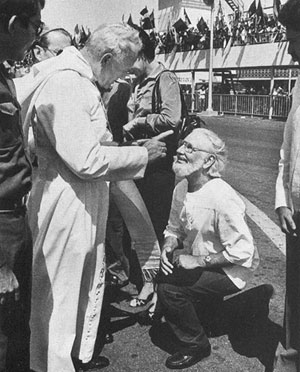
Image: Pope John Paul II reprimanding Father Ernesto Cardenal at Managua Airport for Cardenal’s support of “liberation theology” and his work with the Sandinista government.
It appears that Bergoglio, who was head of the Jesuit order in Buenos Aires during Argentina’s grim “dirty war,” mostly tended to his bureaucratic rise within the Church as Argentine security forces “disappeared” some 30,000 people for torture and murder from 1976 to 1983, including 150 Catholic priests suspected of believing in “liberation theology.”
Much as Pope Pius XII didn’t directly challenge the Nazis during the Holocaust, Father Bergoglio avoided any direct confrontation with the neo-Nazis who were terrorizing Argentina. Pope Francis’s defenders today, like apologists for Pope Pius, claim he did intervene quietly to save some individuals.
But no one asserts that Bergoglio stood up publicly against the “anticommunist” terror, as some other Church leaders did in Latin America, most notably El Salvador’s Archbishop Oscar Romero who then became a victim of right-wing assassins in 1980.
Indeed, the predominant role of the Church hierarchy – from the Vatican to the bishops in the individual countries – was to give political cover to the slaughter and to offer little protection to the priests and nuns who advocated “liberation theology,” i.e. the belief that Jesus did not just favor charity to the poor but wanted a just society that shared wealth and power with the poor.
In Latin America with its calcified class structure of a few oligarchs at one end and many peasants at the other, that meant reforms, such as land redistribution, literacy programs, health clinics, union rights, etc. But those changes were fiercely opposed by the local oligarchs and the multinational corporations that profited from the cheap labor and inequitable land distribution.
So, any reformers of any stripe were readily labeled “communists” and were made the targets of vicious security forces, often trained and indoctrinated by “anticommunist” military officers at the U.S.-run School of the Americas. The primary role of the Catholic hierarchy was to urge the people to stay calm and support the traditional system.
It is noteworthy that the orchestrated praise for Pope Francis in the U.S. news media has been to hail Bergoglio’s supposedly “humble” personality and his “commitment to the poor.” However, Bergoglio’s approach fits with the Church’s attitude for centuries, to give “charity” to the poor while doing little to change their cruel circumstances – as Church grandees hobnob with the rich and powerful.
Another Pope Favorite
Pope John Paul II, another favorite of the U.S. news media, shared this classic outlook. He emphasized conservative social issues, telling the faithful to forgo contraceptives, treating women as second-class Catholics and condemning homosexuality. He promoted charity for the poor and sometimes criticized excesses of capitalism, but he disdained leftist governments that sought serious economic reforms.
Elected in 1978, as right-wing “death squads” were gaining momentum across Latin America, John Paul II offered little protection to left-leaning priests and nuns who were targeted. He rebuffed Archbishop Romero’s plea to condemn El Salvador’s right-wing regime and its human rights violations. He stood by as priests were butchered and nuns were raped and killed.
Instead of leading the charge for real economic and political change in Latin America, John Paul II denounced “liberation theology.” During a 1983 trip to Nicaragua – then ruled by the leftist Sandinistas – the Pope condemned what he called the “popular Church” and would not let Ernesto Cardenal, a priest and a minister in the Sandinista government, kiss the papal ring. He also elevated clerics like Bergoglio who didn’t protest right-wing repression.
John Paul II appears to have gone even further, allowing the Catholic Church in Nicaragua to be used by the CIA and Ronald Reagan’s administration to finance and organize internal disruptions while the violent Nicaraguan Contras terrorized northern Nicaraguan towns with raids notorious for rape, torture and extrajudicial executions.
The Contras were originally organized by an Argentine intelligence unit that emerged from the country’s domestic “dirty war” and was taking its “anticommunist” crusade of terror across borders. After Reagan took office in 1981, he authorized the CIA to join with Argentine intelligence in expanding the Contras and their counterrevolutionary war.
A key part of Reagan’s Contra strategy was to persuade the American people and Congress that the Sandinistas represented a repressive communist dictatorship that persecuted the Catholic Church, aimed to create a “totalitarian dungeon,” and thus deserved violent overthrow.
A special office inside the National Security Council, headed by longtime CIA disinformation specialist Walter Raymond Jr., pushed these propaganda “themes” domestically. Raymond’s campaign exploited examples of tensions between the Catholic hierarchy and the Sandinista government as well as with La Prensa, the leading opposition newspaper.
To make the propaganda work with Americans, it was important to conceal the fact that elements of the Catholic hierarchy and La Prensa were being financed by the CIA and were coordinating with the Reagan administration’s destabilization strategies. [See Robert Parry’s Lost History.]
Evidence of Payments
In 1988, I discovered evidence of this reality while working as a correspondent for Newsweek magazine. At the time, the Iran-Contra scandal had undermined the case for spending more U.S. money to arm the Contras. But the Reagan administration continued to beat the propaganda drums by highlighting the supposed persecution of Nicaragua’s internal opposition.
To fend off U.S. hostility, which also included a harsh economic embargo, the Sandinistas announced increased political freedoms. But that represented only a new opportunity for Washington to orchestrate more political disruptions, which would either destabilize the government further or force a crackdown that could then be cited in seeking more Contra aid.
Putting the Sandinistas in this “inside-outside” vise had always been part of the CIA strategy, but with a crumbling economy and more U.S. money pouring into the opposition groups, the gambit was beginning to work.
Yet, it was crucial to the plan that the CIA’s covert relationship with Nicaragua’s internal opposition remain secret, not so much from the Sandinistas, who had detailed intelligence about this thoroughly penetrated operation, but from the American people. The U.S. public would get outraged at Sandinista reprisals against these “independent” groups only if the CIA’s hand were kept hidden.
A rich opportunity for the Reagan administration presented itself in summer 1988 when a new spasm of Contra ambushes killed 17 Nicaraguans and the anti-Sandinista internal opposition staged a violent demonstration in the town of Nandaime, a protest that Sandinista police dispersed with tear gas.
Reacting to the renewed violence, the Sandinistas closed down La Prensa and the Catholic Church’s radio station – both prime vehicles for anti-Sandinista propaganda. The Nicaraguan government also expelled U.S. Ambassador Richard Melton and seven other U.S. Embassy personnel for allegedly coordinating the disorders.
Major U.S. news outlets, which had accepted their role treating the Sandinistas as “designated enemies” of the United States, roared in outrage, and the U.S. Congress condemned the moves by a margin of 94-4 in the Senate and 385-18 in the House.
Melton then testified before the Senate Intelligence Committee first in secret and then in public, struggling to hide the open secret in Washington that Nicaragua’s internal opposition, like the Contras, was getting covert help from the U.S. government.
When asked by a senator in public session about covert American funding to the opposition, Melton dissembled awkwardly: “As to other activities that might be conducted, that’s – they were discussed – that would be discussed yesterday in the closed hearing.”
When pressed by Sen. Howard Metzenbaum on whether the embassy provided “encouragement – financial or otherwise – of dissident elements,” Melton responded stiffly: “The ambassador in any post is the principal representative of the U.S. government. And in that capacity, fulfills those functions.” He then declined to discuss “activities of an intelligence nature” in open session.
On the Payroll
In other words, yes, the U.S. government was covertly organizing and funding the activities of the supposedly “independent” internal opposition in Nicaragua. And, according to more than a dozen sources that I interviewed inside the Contra movement or close to U.S. intelligence, the Reagan administration had funneled CIA money to virtually every segment of the internal opposition, from the Catholic Church to La Prensa to business and labor groups to political parties.
“We’ve always had the internal opposition on the CIA payroll,” one U.S. government official said. The CIA’s budget line for Nicaraguan political action – separate from Contra military operations – was about $10 million a year, my sources said. I learned that the CIA had been using the Church and Cardinal Miguel Obando y Bravo to funnel money into Nicaragua.
Obando was a plodding but somewhat complex character. In the 1970s, he had criticized the repression of the Somoza dictatorship and expressed some sympathy for the young Sandinista revolutionaries who were trying to bring social and economic changes to Nicaragua.
However, after the murder of El Salvador’s Archbishop Romero in 1980 and Pope John Paul II’s repudiation of “liberation theology,” Obando shifted clumsily into the anti-Sandinista camp, attacking the “people’s church” and accusing the Sandinistas of “godless communism.”
On May 25, 1985, he was rewarded when the Pope named him Cardinal for Central America. Then, despite mounting evidence of Contra atrocities, Obando traveled to the United States in January 1986 and threw his support behind a renewal of military aid to the Contras.
All this made a lot more sense after factoring in that Obando had essentially been put onto the CIA’s payroll. The CIA funding for Nicaragua’s Catholic Church was originally unearthed in 1985 by the congressional intelligence oversight committees, which then insisted that the money be cut off to avoid compromising Obando further.
But the funding was simply transferred to another secret operation headed by White House aide Oliver North. In fall 1985, North earmarked $100,000 of his privately raised money to go to Obando for his anti-Sandinista activities, I learned from my sources.
I was also told that the CIA’s support for Obando and the Catholic hierarchy went through a maze of cut-outs in Europe, apparently to give Obando deniability. But one well-placed Nicaraguan exile said he had spoken with Obando about the money and the Cardinal had expressed fear that his past receipt of CIA funding would come out.
What to Do?
Discovering this CIA funding of Nicaragua’s Catholic Church presented professional problems for me at Newsweek, where my senior editors were already making clear that they sympathized with the Reagan administration’s muscular foreign policy and felt that the Iran-Contra scandal had gone too far in undermining U.S. interests.
But what was the right thing for an American journalist to do with this information? Here was a case in which the U.S. government was misleading the American public by pretending that the Sandinistas were cracking down on the Catholic Church and the internal opposition without any justification. Plus, this U.S. propaganda was being used to make the case in Congress for an expanded war in which thousands of Nicaraguans were dying.
However, if Newsweek ran the story, it would put CIA assets, including Cardinal Obando, in a dicey situation, possibly even life-threatening. So, when I presented the information to my bureau chief, Evan Thomas, I made no recommendation on whether we should publish or not. I just laid out the facts as I had ascertained them. To my surprise, Thomas was eager to go forward.
Newsweek contacted its Central America correspondent Joseph Contreras, who outlined our questions to Obando’s aides and prepared a list of questions to present to the Cardinal personally. However, when Contreras went to Obando’s home in a posh suburb of Managua, the Cardinal literally evaded the issue.
As Contreras later recounted in a cable back to Newsweek in the United States, he was approaching the front gate when it suddenly swung open and the Cardinal, sitting in the front seat of his burgundy Toyota Land Cruiser, blew past.
As Contreras made eye contact and waved the letter, Obando’s driver gunned the engine. Contreras jumped into his car and hastily followed. Contreras guessed correctly that Obando had turned left at one intersection and headed north toward Managua.
Contreras caught up to the Cardinal’s vehicle at the first stop-light. The driver apparently spotted the reporter and, when the light changed, sped away, veering from lane to lane. The Land Cruiser again disappeared from view, but at the next intersection, Contreras turned right and spotted the car pulled over, with its occupants presumably hoping that Contreras had turned left.
Quickly, the Cardinal’s vehicle pulled onto the road and now sped back toward Obando’s house. Contreras gave up the chase, fearing that any further pursuit might appear to be harassment. Several days later, having regained his composure, the Cardinal finally met with Contreras and denied receiving any CIA money. But Contreras told me that Obando’s denial was unconvincing.
Newsweek drafted a version of the story, making it appear as if we weren’t sure of the facts about Obando and the money. When I saw a “readback” of the article, I went into Thomas’s office and said that if Newsweek didn’t trust my reporting, we shouldn’t run the story at all. He said that wasn’t the case; it was just that the senior editors felt more comfortable with a vaguely worded story.
Hot Water
We ended up in hot water with the Reagan administration and right-wing media attack groups anyway. Accuracy in Media lambasted me, in particular, for going with such a sensitive story without being sure of the facts (which, of course, I was).
Thomas was summoned to the State Department where Assistant Secretary of State Elliott Abrams heaped more criticism on me though not denying the facts of our story. Newsweek also agreed, in the face of right-wing pressure, to subject me and the article to an internal investigation, which quietly reconfirmed the facts of the story.
Despite this corroboration, the incident damaged my relations with senior Newsweek editors, particularly executive editor Maynard Parker who saw himself as part of the New York/Washington foreign policy establishment and was deeply hostile to the Iran-Contra scandal, which I had helped expose.
As for Obando, the Sandinistas did nothing to punish him for his collaboration with the CIA and he gradually evolved more into a figure of reconciliation than confrontation. However, the hyper-secretive Vatican has refused to open its archives for any serious research into its relationship with the CIA and other Western intelligence services.
Whenever allegations do arise about the Catholic Church’s hierarchy winking and nodding at the kinds of human rights atrocities that claimed hundreds of thousands of lives in Latin America during the 1970s and 1980s, the Vatican PR department lashes out with sternly worded denials.
That practice is playing out again in the days after the election of Pope Francis I. Rather than a serious and reflective assessment of the actions (and inactions) of Cardinal Bergoglio, Cardinal Obando, Pope John Paul II and other Church leaders during those dark days of torture and murder, the Vatican simply denounces all allegations as “slander,” “calumny” and politically motivated lies.

Investigative reporter Robert Parry broke many of the Iran-Contra stories for The Associated Press and Newsweek in the 1980s. You can buy his new book, America’s Stolen Narrative, either in print here or as an e-book (from Amazon and barnesandnoble.com).

Linggo, Setyembre 15, 2013

MATAPANG AKO

ALL OUT NA PO ITO! UUBUSIN PO NATIN SINA MISUARI AT ANG MNLF. THEIR DAYS ARE NUMBERED!
Di po natin titigilan and laban. We will make them surrender!
Gegerahin po natin araw-araw!
Gagamit po tayo ng makabagong teknolohiya!


Martes, Enero 29, 2013

GREEDY AND DECEPTIVE JESUITS

DONT EVER BELIEVE THE JESUITS OF THE ATENEO.

MUKHA TALAGANG MGA PERA IYAN. SA ANTI-MINING ISSUE NALANG NG BANSANG ITO, THEY FLIPPED-FLOPPED WHEN MANNY PANGILINAN WITHDREW HIS MILLIONS OF PESOS IN SHARES AND SUPPORT OF THE UNIVERSITY.

APPARENTLY, MANNY WAS IRKED WHEN THE ATENEO BRANCH IN MANILA AND DAVAO STEPPED ON THEIR CAMPAIGN IN ANTI-MINING, WHEN MANNY, WHO WAS A VERY CAREFUL AND CONSCIENTIOUS INVESTOR IN THAT AREA, WAS NOT EVEN CONSULTED BY THESE GREEDY PRIESTS. AS AN INVESTOR IN THE ATENEO EDUCATION, HE CONSIDERED THIS AS AN AFFRONT ON HIS DIGNITY AND GENEROSITY.

THE JESUITS OF DAVAO CITY IMMEDIATELY RECANTED AND "RECLASSIFIED" THEIR STANCE ON THE ANTI-MINING ISSUE.

MUKHA TALAGANG MGA PERA ANG JESUITS. WE KNOW THIS. SOME OF US, OUR FRIENDS AT THIS BLOG, PREVIOUSLY TOOK UP JESUIT EDUCATION IN NAGA, ZAMBOANGA AND MANILA.

EVER WONDER WHY SILENT SILA SA MGA ABUSES NI PNOY???

THINK ABOUT IT FRIENDS.